Thin or full espresso: what determines the body?
You pull a shot and taste: watery. A disappointment. The next day you use exactly the same beans and the result is full, round and creamy. How? The answer isn’t in the bean, but in the dials you turn. The body of your espresso is entirely your domain.
What body actually is
Body is the physical weight of the coffee on your tongue. It’s a part of mouthfeel, completely separate from flavor. Compare it to the difference between skim milk and whole milk. The flavor is different, but the feel in your mouth is the real judge. One is thin and light, the other heavy and coating. That weight, that texture, is the body. In an espresso this can range from tea-like and light to syrupy and heavy.
Grind size and particles determine the weight
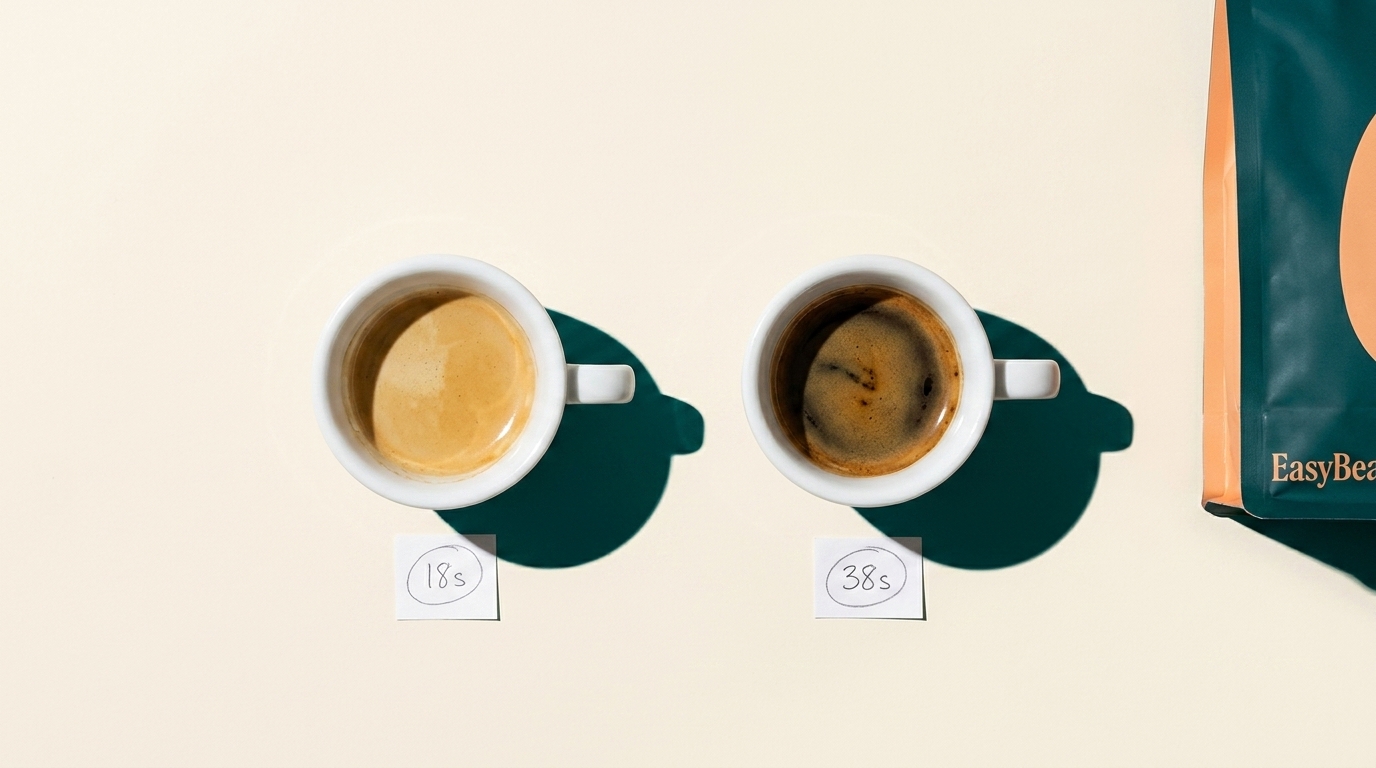
You’ve probably had a shot that ran through fast and tasted like colored water. Chances are your grind was too coarse. A finer grind creates more contact area between the water and the coffee. As a result the water dissolves more solid particles and carries them into your cup. These dissolved particles, also called total dissolved solids (TDS), literally give the liquid more weight. An espresso with a higher particle concentration feels heavier and fuller. A coarser grind lets the water pass too quickly, so fewer particles dissolve and you get a thinner-bodied espresso.
Ratio and extraction time control the thickness
Besides weight there’s also thickness. You steer this mainly with your ratio: the relationship between the amount of dry coffee and the liquid espresso. A classic espresso at a 1:2 ratio (18 grams of coffee in, 36 grams of drink out) already feels fairly full. But if you use that same 18 grams for a tighter 1:1.5 ratio (27 grams of drink out), you create a much more concentrated, almost syrupy result. You use less water to extract the flavor, which makes the drink thicker. A longer extraction time can also add to a fuller espresso, because the water has more time to pull the heavier, oilier components out of the coffee.
Fat and crema add roundness
That golden-brown layer on top of your espresso is more than decoration. Crema is an emulsion of coffee oils, water and carbon dioxide (CO2) released during brewing under high pressure. Those oils are essential to mouthfeel. They give the espresso a creamy, soft texture that rounds off the sharper flavors. A shot with a thin, quickly disappearing crema often feels sharper and more watery. A shot with a thick, stable crema feels softer and rounder, as if a little cream had been stirred in.
Frequently Asked Questions
Is a fuller espresso also stronger?
Not necessarily in caffeine, but yes in flavor intensity. A fuller body comes from a higher concentration of dissolved coffee particles. So you taste more coffee per sip, which most people experience as “stronger.” The amount of caffeine depends more on the bean used and the amount of coffee.
Which adjustment gives the fastest result for more body?
Setting your grind finer. This is the most powerful dial you can turn. A small change has an immediate, large effect on the flow time and the amount of particles in your shot, which you feel right away as a heavier body.
Can I increase the body without making the espresso bitter?
Definitely. Bitterness often comes from over-extraction, for example when you grind too fine and the flow time gets too long. Instead, try playing with your ratio. A slightly tighter ratio, say from 1:2.5 to 1:2, gives you more body without stretching the extraction time so far that bitterness takes over.
In closing
Body, like astringency or dryness, is a puzzle piece of mouthfeel. It’s not a matter of right or wrong, but of preference. One person likes a light, clear shot, another a thick, syrupy experience. Experiment with these variables and find what works for you. Our dial-in recipe is made for exactly this: a concrete starting point to work from, shot by shot.
See also: Coffee mouthfeel: the variable nobody explains, Why does your espresso taste harsh or dry?