Espresso too sour or too bitter? Here's how to fix it (in 3 steps)
You’ve just pulled a shot of espresso. The crema looks good, the smell is promising. You take a sip and disappointment follows. It’s painfully sour, like biting into a lemon, or unpleasantly bitter and dry, like it’s burnt. You’re not alone: this happens to every home barista. The good news is that it’s almost never your fault and certainly not your machine’s. Usually it’s a matter of nudging your recipe a little.
This article is your direct helpline. We explain what you’re tasting, why you’re tasting it and how to fix it with a few simple adjustments. No complicated theory, just a practical guide to making your next shot taste good.
Sour vs. bitter: what are you actually tasting?
The first step is recognizing what’s going wrong. Sour and bitter are often confused, but they’re two completely different tastes with opposite causes.
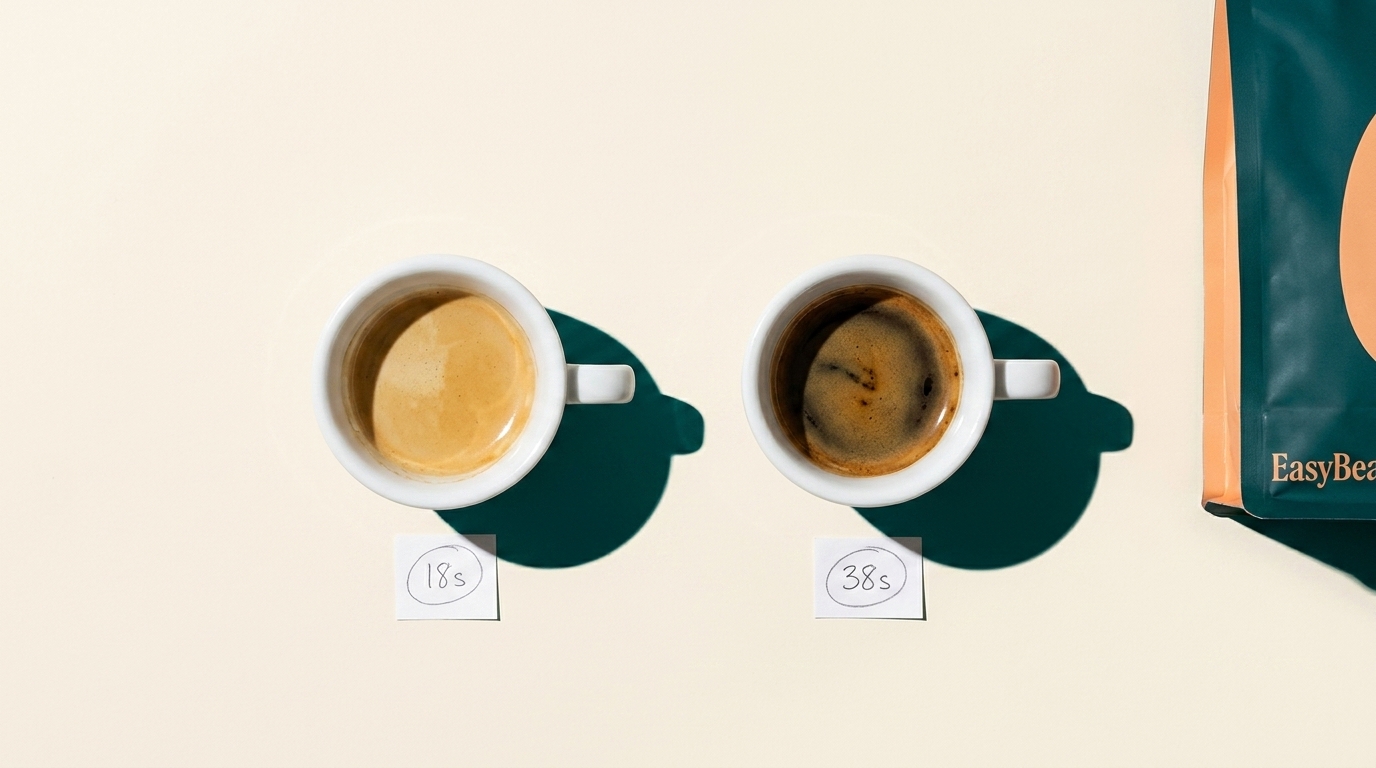
- Sour (under-extraction): a sharp, sometimes biting taste you feel mostly on the sides of your tongue. It recalls unripe fruit or lemon juice, and often disappears quickly. Your espresso isn’t extracted far enough.
- Bitter (over-extraction): a harsh, dry and sometimes burnt taste that lingers at the back of your throat, with a rough, puckering feeling in your mouth. Think of the taste of dark, plain chocolate or burnt toast. Your espresso is extracted too far.
A little bitterness isn’t wrong, by the way. A good espresso has balance, with a hint of the pleasant bitterness of cocoa. It’s the dominant, unpleasant bitterness you want to avoid.
What actually happens during extraction
When hot water flows through ground coffee, it dissolves different flavor components, and that happens in a predictable order. Think of it as a timeline:
- First the acids. The fruity and sour flavors dissolve first. If you stop the extraction here, you get a sour shot: under-extraction.
- Then the sweetness and body. Next the sugars and oils are released, which give the espresso its sweetness, complexity and syrupy texture. This is the point you’re working toward.
- Last the bitters. If the water keeps flowing through the coffee too long, it also dissolves the bitter compounds. That leads to a bitter, dry flavor: over-extraction.
Your goal as a home barista is to stop the extraction right in the middle, where the sweetness balances the acids and the bitters haven’t taken over yet. Grind size is your most important dial here. A finer grind slows the water down, which gives a longer contact time and therefore more extraction. A coarser grind speeds the water up, which shortens the contact time and reduces extraction.
Espresso too sour: causes and fixes
A sour espresso means the water ran through the coffee too fast and didn’t have time to dissolve the sweet flavors. That’s under-extraction.
| Cause | Signal | First action |
|---|---|---|
| Grind too coarse | Shot runs too fast (shorter than 22 sec), blonde crema, watery body | Set grind one click finer |
| Too little coffee (dose) | Shot runs fast, even at a fine grind | Raise dose by 0.5 grams |
| Water temperature too low | Flavor is sour and flat, lacks depth | Raise temperature by 1 to 2°C, if possible |
| Beans too light roasted | You taste lots of fruitiness, but it tips over into aggressive sour | Choose a medium or dark roasted bean |
| Beans too old | Flavor is hollow and sour, little crema, shot spits | Use fresher beans, between 7 and 30 days after roast date |
| Pre-infusion too short | Even with the right flow time the shot stays sharp and sour | Extend pre-infusion by 1 to 2 seconds, if possible |
How to fix a sour espresso, step by step:
- Start with the grind. This is the cause in most cases, and your goal is to lengthen the flow time of your shot so the water has more time to pull out flavors.
- Grind one click finer. Change nothing else about your recipe: keep dose and yield the same.
- Pull a new shot and time the flow. Does it now run in 25 seconds instead of 20? Then you’re on the right track.
- Taste again. If the sharp sourness is gone and you taste more sweetness, you’re good. If it’s still too sour, go back to step 2 and grind one more click finer.
Keep repeating this process until you have a balanced shot, usually with a flow time between 25 and 32 seconds. Want to tackle this systematically? Read the complete guide on dialing in espresso.
Espresso too bitter: causes and fixes
A bitter espresso means the water ran through the coffee too slowly and dissolved too many bitter compounds. That’s over-extraction.
| Cause | Signal | First action |
|---|---|---|
| Grind too fine | Shot runs too slow (longer than 35 sec) or drips, dark crema | Set grind one click coarser |
| Too much coffee (dose) | Shot runs slow, even at a coarser grind | Lower dose by 0.5 grams |
| Water temperature too high | Flavor is bitter and burnt, even at a correct flow time | Lower temperature by 1 to 2°C, if possible |
| Waited too long | Let the machine run too long for a bigger yield | Stop the shot earlier, at the target yield |
| Beans dark roasted | You taste mostly smoky, burnt flavors | Choose a medium roasted bean for more balance |
| Dirty machine or portafilter | Bitterness tastes rancid and old, regardless of the settings | Clean group head and portafilter thoroughly |
An often-forgotten cause of bitterness is a dirty machine. Old coffee residue and oils in the group head or portafilter get reheated with every shot and dissolve into your espresso. That gives a rancid, harsh bitterness no setting fixes. Regular flushing and cleaning is therefore just as important as grind size.
How to fix a bitter espresso, step by step:
- Start with the grind here too. This is the most likely culprit, and you want to shorten the flow time.
- Grind one click coarser. Change nothing else about your recipe.
- Pull a new shot and time the flow. You’ll notice the water now flows through the coffee faster.
- Taste again. Is the harsh, dry bitterness gone? Good. Still too bitter? Grind one more click coarser.
If you have a Rancilio Silvia or Gaggia Classic Pro Evo, your machine has no digital temperature control. The tables above then say “if possible” for temperature, but you can steer the boiler temperature: with temperature surfing.
The decision tree, in brief
Not sure where to start? Use this quick diagnosis. Taste first: sour or bitter? Then check the extraction time. Sour and fast (under 22 seconds) → grind finer. Bitter and slow (over 35 seconds) → grind coarser. Sour and bitter at the same time, with a normal flow time → the cause is channeling, a dirty machine or water quality, not the grind.
When isn’t it the grind or dose?
Sometimes grind size and dose are exactly right, but the espresso keeps disappointing. Then something else is going on. These are the most common alternative causes.
Poor water quality
Your espresso is more than 98 percent water. If your water isn’t good, your coffee can’t be either. Water that’s too hard, with a lot of limescale, dampens the flavors and damages your machine. Water that’s too soft, without minerals, gives a flat, hollow and often sour flavor. Filtered water with a good mineral balance gives the best result.
Dirty machine or portafilter
This can’t be stressed enough. Dried coffee oils turn rancid and give a harsh, chemical bitterness that has nothing to do with the bean itself. Clean your portafilter after every shot and flush your machine daily to weekly, depending on usage.
Coffee that doesn’t match your taste
Taste is personal. A light-roasted Kenyan bean naturally has a higher acidity and more fruitiness. If you try to dial it in as if it were a dark-roasted Brazilian bean, it will always feel a bit sour. That’s not a fault, but a characteristic of the bean. If you consistently get sour results, try a medium or darker roasted coffee.
Beans too old
Coffee beans are a fresh product. After about four to six weeks past the roast date they lose most of their aromas and the carbon dioxide needed for a good extraction. Old beans give a shot that runs through fast, has little crema and often a hollow, sometimes sour or musty flavor. Read more about this in how old can coffee beans be.
Uneven extraction (channeling)
Channeling happens when the water doesn’t flow evenly through the coffee puck, but takes the path of least resistance. Small channels form where the water sprays through. Over-extraction happens at those spots, which tastes bitter, while the rest of the puck stays under-extracted and tastes sour. The result is a confusing shot that tastes sour and bitter at once. The cause is usually poor distribution of the coffee in the portafilter or crooked tamping. A WDT tool helps distribute the ground coffee evenly before you tamp. Want to fully understand the technique and the science behind it? Read the article on WDT, RDT and puck prep.
How to prevent it with your next bag
Consistency is the key to good espresso. Adopt these five habits, and you’ll notice you need to adjust much less often.
- Always weigh your dose and your yield. Use a scale accurate to 0.1 gram. Working by eye is the recipe for inconsistent shots.
- Distribute the coffee evenly. Make sure the ground coffee forms an even bed in the portafilter before you tamp. Use a WDT tool or tap gently against the side.
- Tamp consistently and straight. The amount of force matters less than always using the same force and keeping the tamper straight.
- Note your recipe. For each new bag of beans, write down which grind size, dose and yield worked well. That gives you a good starting point for next time.
- Taste deliberately at the first sip. Take a moment to analyze what you taste — sour, bitter or balanced. That helps you understand faster which adjustment is needed.
Frequently Asked Questions
Should I grind finer or coarser for sour espresso?
For a sour espresso you always grind finer. Sour is a sign of under-extraction: the water flows through the coffee too fast. By grinding finer you raise the resistance in the coffee puck, so the water flows more slowly and gets more time to dissolve the sweet and complex flavors. That balances the sourness.
Is sour espresso bad?
There’s an important difference between unwanted sourness and desirable acidity. Sourness is sharp, unpleasant and a sign of a failed extraction. Acidity is the clear, lively and fruity flavor you find in many high-quality, light-roasted coffees, with notes recalling juicy fruit or berries. A bit of acidity is actually a sign of a complex, interesting coffee. Only when it feels unpleasantly sharp is it an extraction fault.
Why does my espresso taste sour in the morning but not in the afternoon?
This is usually due to the temperature of your machine. In the morning the group head and portafilter often aren’t fully warmed up. A group head that’s too cold cools the water down, which leads to a lower extraction temperature and therefore a sour espresso. Let your machine warm up for at least 20 to 30 minutes and flush the group head and portafilter with hot water before your first shot.
How quickly should I brew my espresso after grinding?
As fast as possible, ideally within a minute. Once beans are ground, the surface area becomes enormously larger, volatile aromas are released quickly and the coffee starts to oxidize. That affects the flavor negatively. Grinding fresh for every shot is one of the most important steps toward a tasty espresso.
Why does my espresso taste sour or bitter when the grind is right?
If your flow time is correct, say 28 seconds, but the flavor still isn’t, look at other variables. The most common cause is channeling, uneven extraction, which gives a confusing mix of sour and bitter flavors. Other possibilities are a wrong water temperature or a dirty machine that gives a bitter aftertaste.
Is bitter espresso always a fault?
No, not necessarily. A certain amount of bitterness belongs in coffee and is even desirable for balance, like the pleasant bitterness of dark chocolate or cocoa. That gives depth and a long aftertaste. It only becomes a problem when the bitterness dominates, tastes sharp, dry or burnt. Then there’s over-extraction, and it’s time to adjust your recipe.
Espresso too sour, how exactly do I adjust the grind?
The key is to work in small steps. Adjust the grind size on your grinder by just one click or the smallest possible unit, and then pull a new shot with exactly the same dose. That way you always adjust one variable at a time and know exactly what the effect is. If you change grind size and dose at the same time, you never know which of the two changed the flavor.
Can uneven extraction (channeling) cause sour or bitter espresso?
Yes, channeling causes both at once. The water shoots through channels in the puck, so the coffee there is over-extracted and tastes bitter, while the denser parts of the puck are barely touched and stay sour. The result in your cup is a messy, unpleasant mix of sour and bitter, without the sweetness that normally connects the two.
In closing
A disappointing shot of espresso isn’t a disaster, but a learning moment. In most cases a simple adjustment of your grind size is the solution. Always start there. Does your shot run too fast and taste sour? Grind finer. Does it run too slow and taste bitter? Grind coarser.
If that doesn’t solve the problem, use the decision logic and the list of alternative causes above to keep looking. Consistency in your preparation and adjusting only one variable at a time remains the fastest route to a balanced shot.
Want an in-depth, systematic approach? See the complete guide on dialing in espresso. Don’t have a good starting recipe for your beans yet? Calculate your recipe at /startpunt and start with a solid base.
See also: Dialing in espresso: the complete guide, WDT, RDT and puck prep, How old can coffee beans be?