How old can your coffee beans be? (And what to do about it)
You make your espresso. Same beans as last week. Same recipe. But something is off.
The crema is thinner. The flavor flatter. You run the standard checklist: grind, tamp, temperature. Everything is set right. Yet the shot feels different.
It’s probably the beans. Not the machine. Not you. The bean changes every day after roasting — chemistry, not opinion. If your recipe doesn’t move with it, the coffee picks that up.
Good news: this is fully controllable. You don’t have to experiment endlessly. You only need to understand how freshness works — and then make one simple adjustment.
What happens to coffee beans after roasting?
During roasting, coffee beans are exposed to extreme heat. That heat starts chemical reactions that turn the bean into a factory of volatile flavor compounds. After roasting, the bean isn’t finished. Three things happen — and each has a direct effect on how your espresso tastes.
CO₂ degassing. After roasting, the bean is filled with carbon dioxide. That gas escapes over the following hours and days. In the first two or three days this happens fast. Too fast, really: that much CO₂ in the portafilter gives an unstable extraction. The crema is enormous but disappears immediately. The flavor is hollow. That’s not your settings mistake — it’s just chemical reality. Wait a bit longer.
Oxidation. Once the CO₂ is gone, oxygen takes its place. Oxygen and aroma compounds are no friends. Oxidation slowly degrades the volatile compounds that give your coffee its depth. The Maillard reaction products from roasting — the compounds behind chocolate, nut and caramel flavors — break down. The flavor turns flatter, sharper, sometimes cardboard-like.
Humidity and heat. They speed everything up. A warm kitchen, an open bag, daylight — each factor accelerates oxidation. The solution is simple: cool, dark, airtight.
What’s interesting is that this isn’t a disaster scenario. It’s a predictable process. And a predictable process is something you can steer.
The freshness timeline for espresso
There’s no fixed expiry date for espresso. There’s a curve. Here’s what it looks like:
| Time after roasting | State | Espresso quality | What do you do? |
|---|---|---|---|
| 0–3 days | Hyper-fresh | ❌ Unstable — too much CO₂ | Wait |
| 4–6 days | Almost ready | ⚠️ A bit messy | Possible, but not at its best |
| 7–21 days | Sweet spot | ✅ Optimal | Use now |
| 21–45 days | Declining | ⚠️ Noticeably flatter | Grind slightly finer |
| 45–90 days | Old | ❌ Clearly reduced | Grind finer + adjust ratio |
| 90+ days | Stale | ❌ Bitter or cardboard-like | Different use |
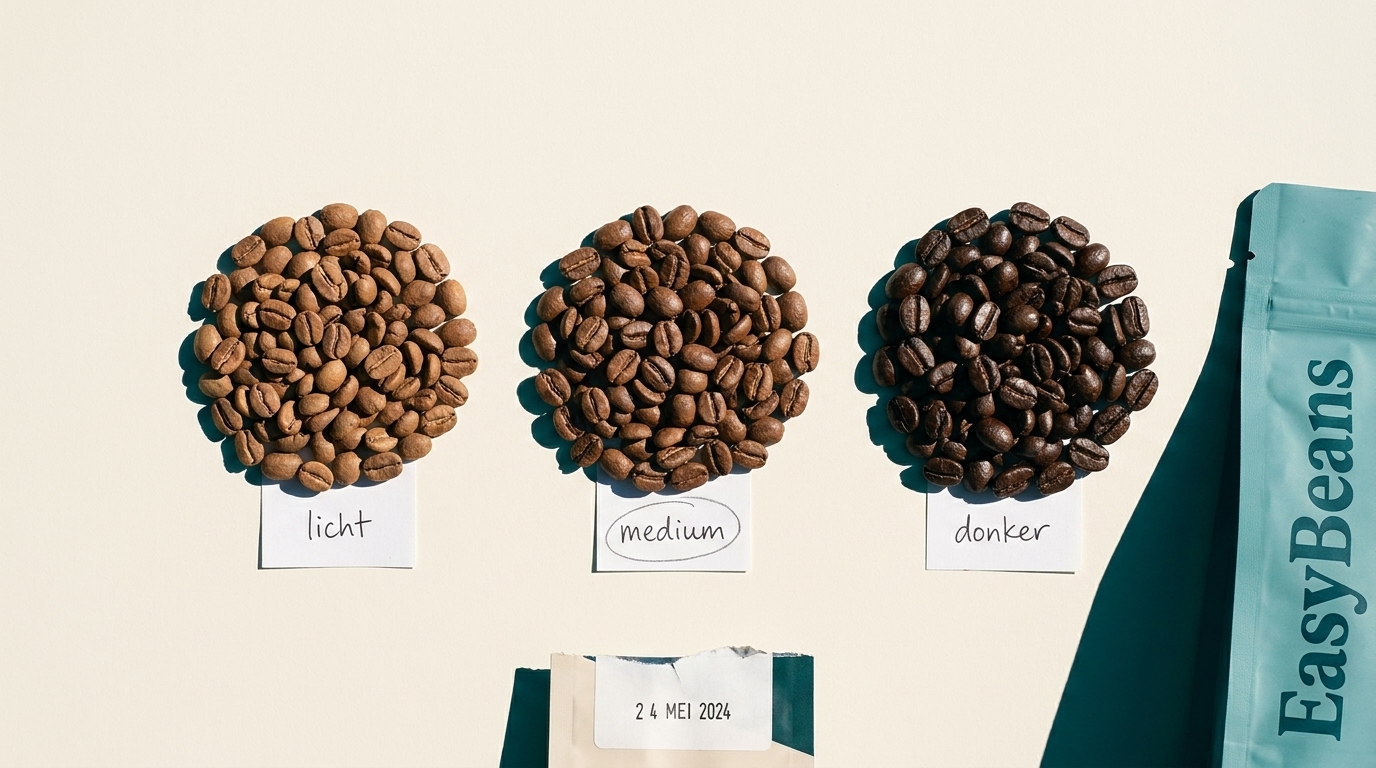
The 7–21 day sweet spot isn’t an exact law. A light-roasted single origin sometimes wants 10–14 days of rest before it really opens up. A darker roast is ready after 5–7 days. The bean decides, not the calendar.
What always holds: the bean changes and the recipe is allowed to think along. Beans from day 8 and beans from day 35 are not chemically the same bean. A recipe that delivers both perfectly doesn’t exist. What you can do is adjust. Grind slightly finer as the bean gets flatter. Extend the extraction time a touch if the flavor falls flat too fast. Small corrections, not full recalibrations.
Baristas call this “dialing in.” Not once with the first bag — with every bag, every few weeks again. That sounds like a lot of work. In practice it’s one small turn of the grinder and a deliberate test shot.
How do you notice your beans are too old?
No scale needed. Your senses tell you.
The crema disappears immediately. Fresh beans give a compact, caramel-colored crema on espresso that holds for a few seconds. Beans past their best give little crema — or a thin, quickly disappearing layer of foam that’s already gone by the time you sit down.
The shot runs faster than normal. Beans shrink slightly as they age. Same grind, but the coffee bed has become looser. Result: the shot runs through in 18 seconds when you expected 27. You think your grind has shifted. It hasn’t — the bean has changed. Grinding finer corrects it.
The smell while grinding is weak. Good beans smell intense while grinding — roasted, sometimes floral, sometimes nutty. Old beans smell musty, flat or like cardboard. If your nose gets nothing while grinding: writing on the wall.
Flavor is bitter or sharp without depth. Not the bitterness of a dark roast, but a flat, sharpish bitter. The nuances are gone. There’s no long finish. It’s just coffee — not your coffee.
The beans feel dry. Fresh beans are slightly oily on the surface. The oils are still in them. Beans that have sat for a while are dry, sometimes powdery. The oils have oxidized. You can literally feel it.
If you recognize three of these five signals, your beans are past their best. Don’t throw them away — adjust. Or use them for filter coffee, which is less sensitive to freshness.
What does EasyBeans do differently?
Most storage advice treats coffee beans as if they’re static. “Store them well and they stay fresh for a month.” That’s technically correct but misses the point.
A bean on day 10 is different from the same bean on day 30. The flavor changes. The extraction characteristic changes. If your recipe doesn’t move with it, the coffee picks that up — and you think there’s something wrong with your machine or your technique.
There’s nothing wrong. The bean has just gotten older.
EasyBeans includes a starting-point recipe with every order. Not a one-time setting, but a starting point with explanation: in week 1 and 2 this is the recipe. As the bag goes on — week 3, week 4 — you adjust the grind slightly. Maybe correct the ratio a little. Small steps, but you stay in the sweet spot.
→ Calculate your starting point at /startpunt
Practical storage advice
You can’t stop the aging curve. You can slow it down — considerably.
Airtight packaging with a one-way valve. A valve bag lets CO₂ escape but keeps oxygen out. That’s the standard for specialty coffee. A storage jar with a vacuum seal is a good second option. Don’t put the beans in an ordinary container with a lid — air gets free rein and you lose three to five days of freshness.
Room temperature, dark. Not in the fridge. Fridge means condensation when the beans come out — humidity accelerates oxidation. The freezer works for bulk storage over months, but only if you let the beans thaw completely before use. Room temperature, away from the stove, away from the window.
Buy small amounts. Better 250g fresh than 1kg that ages halfway through. The 7–21 day freshness sweet spot is easier to hit if you know you’ll finish the bag within three weeks. 500g if you pull espresso daily; 250g if you take it easier.
Only grind what you need. Ground coffee oxidizes 4 to 10 times faster than whole beans. Grinding gives oxygen access to the inside of the bean. Buy a grinder, grind per session. The difference isn’t subtle.
Look at the roast date, not the best-before date. The best-before date on the packaging is a minimum guarantee, not a quality guarantee. For specialty espresso, the roast date is the relevant information. If it’s not on there, that’s information too.
Frequently Asked Questions
How long do coffee beans last?
For specialty espresso the sweet spot is 7–21 days after the roast date. After that the beans are still usable up to 45–60 days, but the flavor is noticeably less intense. After 90 days the quality has clearly declined — the beans are safe but no longer at their best.
When are coffee beans too old for espresso?
There’s no hard limit. The signals are: crema disappears immediately, shot runs faster than normal, smell while grinding is weak or musty, flavor is flat-bitter without depth. If you recognize three of these four, your beans are past their best.
Can I still use coffee beans that are too old?
Yes — always safely, not always tasty. Beans older than 60 days are fine for filter coffee, cold brew or cooking and baking. For top-level espresso: plan new beans.
What about the best-before date on the packaging?
That date is a minimum guarantee for storage, not the peak-quality period. For specialty espresso you look at the roast date, not the best-before date. A bean that’s still “good” four months after roasting hasn’t tasted its best for a long time.
Do I need to rest freshly roasted coffee beans?
Yes. In the first 3–5 days after roasting, a lot of CO₂ is still escaping. That gives an unstable extraction — big crema that disappears immediately, hollow flavor. For espresso: wait at least 5–7 days after the roast date. 10–14 days is more comfortable, and for light-roasted single origins sometimes even necessary.
Does coffee age faster after opening the packaging?
Yes, considerably. An unopened valve bag slows oxidation because CO₂ keeps the oxygen out. After opening: store airtight in a dark environment, use within 2–3 weeks for the best result.
Why does my espresso taste different from last week?
Same beans, but the bean has gotten older. The freshness curve is doing its work. Two weeks on means a slightly flatter flavor and a looser extraction characteristic. Grinding slightly finer helps — the recipe is allowed to think along with the bean.
In closing
Coffee beans don’t have a good-or-bad line. They have a curve. That curve is predictable, and a predictable process is something you can steer.
Baristas know this. They don’t endlessly buy new bags because the last one was “too old” — they adjust. Grind finer as the bean gets flatter. Correct the extraction time a little. Small steps, but they stay in contact with the bean.
The EasyBeans starting-point recipe isn’t meant as a fixed setting. It’s a starting point that moves. Week 1 is different from week 3. Once you know that, you never have to be disappointed by a flavor change again — you steer it.
When it’s right, you know why. It’s that simple.