Which coffee beans do you choose as a beginner? The guide for your first espresso machine
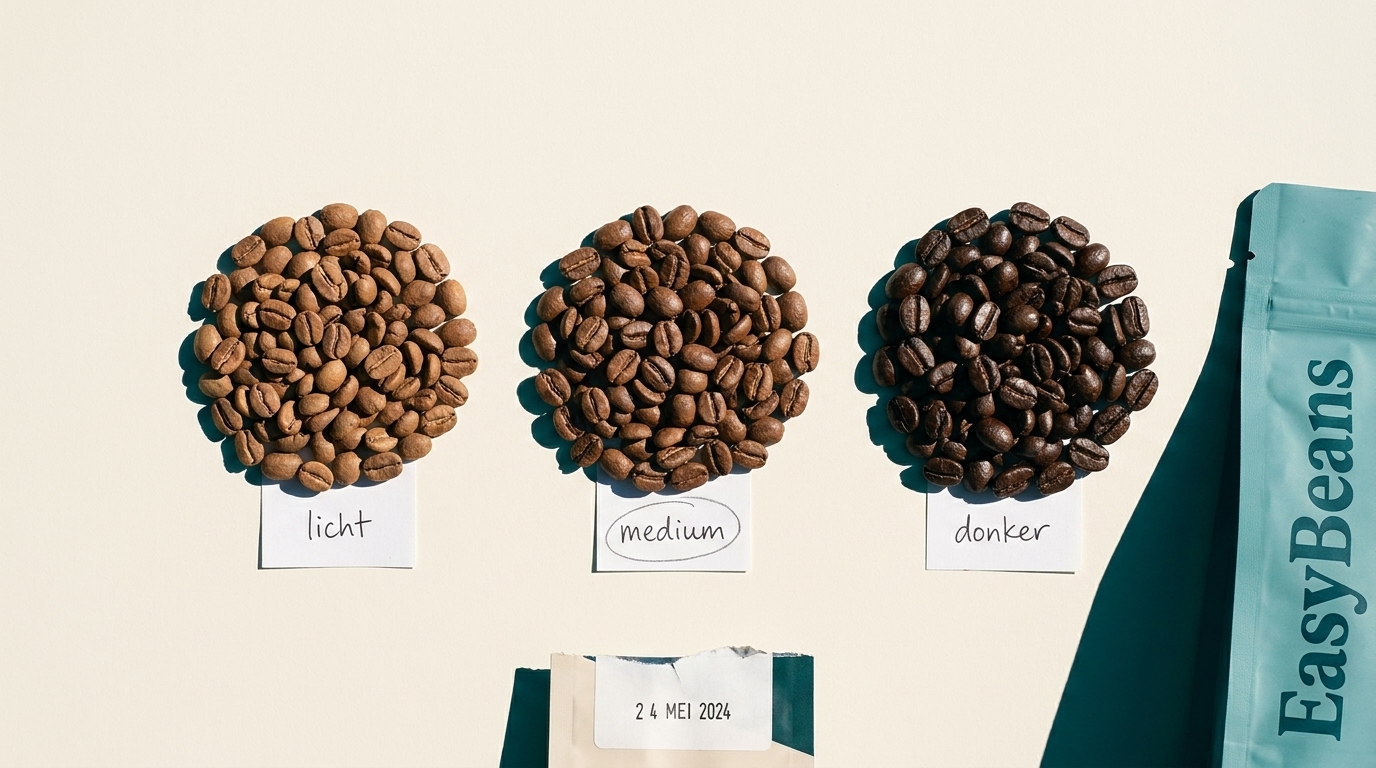
You’ve bought an espresso machine. Now you’re standing in the shop or scrolling through a webshop with dozens of bags of coffee, and none of the labels explain what you should actually choose. Here’s the short answer: choose fresh, medium-roasted beans with a roast date on them, in a 250-gram bag. The rest of this article explains why, and what you can do after that.
This isn’t complicated. It only feels complicated because nobody explains it to you in plain language. So that’s what we do here.
What should you look for when choosing coffee beans?
Before you look at brands or flavors, there are four things that really make a difference. These are the dials you can turn yourself, regardless of which brand you end up buying.
1. Freshness: the most important dial, and the most ignored
Coffee beans are a fresh product, not a shelf-stable one. From the moment they’re roasted, they change every day. For espresso that’s extra noticeable, because you grind the beans fine and put them under pressure. Small differences in freshness then become big differences in flavor.
So look for a roast date on the packaging, not a best-before date. Those two are often confused. A best-before date only says when the beans are no longer safe to drink, usually a year or more after roasting. A roast date says when the beans are at their best, and that’s a window of a few weeks.
Supermarket coffee rarely has a roast date. That’s no coincidence — it would immediately show how old the beans actually are. So skip supermarket coffee in your search for a good coffee bean.
Tip: the freshness of your beans also determines how you need to set your espresso machine. Fresh beans grind differently from old beans. So you may need to adjust the grind size of your espresso machine as your beans age, or when you switch from fresh to old beans.
2. Blend or single origin: no right or wrong, but a difference
A blend is a mix of beans from different countries, composed to taste the same every time. Handy if you want to know exactly what you’re getting.
Single origin comes from one place, often even from one farm or cooperative. The flavor varies per harvest, but you taste much more clearly what freshness and grind size do to a cup of coffee. For someone who wants to learn, that’s valuable: you learn faster what you’re adjusting because you taste the difference better.
For a beginner, a forgiving single origin works best: enough character to learn from, but not so unpredictable that every shot is a surprise.
3. Light, medium or dark roast
This is where most confusion arises, and where many webshops advise you wrong. Here’s the overview in plain language.
| Roast | Flavor | How easy to learn on |
|---|---|---|
| Light roast | Fruity, more acidic, complex | Harder: you taste small grinding mistakes right away |
| Medium roast | Balanced, chocolate and nuts | Easiest: wide margin, little chance of a failed shot |
| Dark roast | Smoky, bitter, little nuance | Easy to grind, but little nuance to learn from |
Many advice pages recommend dark-roasted beans for an espresso machine, arguing that they give “more body.” That’s true for intensity, not for learning. Dark beans mask mistakes with bitterness instead of letting you taste what you’re doing. Medium-roasted coffee beans give you more nuance without sacrificing flavor.
4. Quantity: buy small
A 250-gram bag is enough for about two to three weeks at one or two espressos a day. That’s exactly the window in which the beans are at their best. A kilo seems better value, but by the time you get through it, you’re mostly drinking beans that have already had their best moment. So don’t buy more than you’ll finish in two to three weeks.
Tip: many roasters offer a subscription to save on shipping costs. That way you can still buy small without paying too much.
Which coffee beans are best for a beginner?
In short: medium-roasted specialty coffee, preferably single origin, freshly roasted within the last few weeks, in a small bag.
“Specialty,” by the way, isn’t a marketing word, it’s a quality mark. It means the beans have been carefully selected and that you can trace where they come from. In practice you notice this in flavor and in consistency: the same bag gives you roughly the same shot every day, which is exactly what you need while you’re still learning.
For your first bags (or preferably always), avoid beans without a roast date, and avoid very dark beans purely because “dark = strong” sounds right. Strong says nothing about whether the shot is good. A good shot starts with a bean that gives enough to taste, and leaves enough room when your grind isn’t quite right yet.
Tip: once, test a dark-roasted and a medium-roasted coffee bean side by side and compare the flavor and texture yourself. It’ll surprise you how different they are.
What makes a bean forgiving and suitable to learn on?
“Medium roast” on the label is no guarantee that a bean is forgiving. That’s not in the label, but in the choices the roaster makes before the bean goes into the bag.
Every bean goes through a curve during roasting: how fast the temperature rises, how long the bean keeps roasting after first crack, and how evenly that happens across the whole batch. A roaster who deliberately steers for forgiveness gives the bean just enough development time to round off sharp acidity, without roasting out the nuance. Just as important: every bean in the bag is then evenly roasted. Unevenly roasted beans give varying shots, even when your setting is the same every time. Then the problem seems to be with you, while it’s with the bean.
Not every origin lends itself to this equally well. Some beans naturally have a wide tolerance window — small deviations in grind or time still give a drinkable shot. Other beans are more sensitive, even at exactly the same roast. A roaster who roasts specifically for beginners therefore first chooses an origin with that wide window and then tunes the roast curve to protect that window, instead of roasting for the most pronounced flavor profile possible.
That’s exactly why not every medium-roasted bean in the shop is suitable to learn on. Some are medium-roasted because that simply sells the widest, not because the roaster deliberately tuned the bean for it. You can’t see that difference from the outside of the bag.
EasyBeans selects and roasts specifically for this: origins with a wide tolerance window, roasted to protect that window instead of maximizing flavor intensity. That’s a deliberate choice in the roasting process, not a lucky hit.
Why “fresh” isn’t the same as “just ground”
Another misconception that makes choosing harder than necessary: freshly ground coffee isn’t automatically fresh coffee. You can have eight-month-old beans ground right in front of you, and still get coffee that’s flat and flavorless. Grinding makes the smell stronger, but it doesn’t make the bean younger.
Freshly roasted beans keep releasing gas for a few days after roasting, mostly CO₂. Baristas call this “degassing.” Right after roasting, that gives an unstable shot: lots of crema that sinks away immediately, a hollow flavor. After about five to seven days of rest, that calms down, and between one and three weeks after the roast date most beans are in their best window.
In short: look at the roast date, not the moment you grind.
How do you get the most out of your coffee beans?
You’ve chosen the right beans. Now make sure you don’t ruin them before they reach your cup.
- Store them airtight, dark and at room temperature. Light and air are the fastest way to make beans lose their flavor. The original bag with the valve works fine, just fold or clip it closed properly.
- Not in the fridge or freezer. That sounds logical because it “keeps things fresh,” but coffee beans absorb moisture and smells from other food. Room temperature, away from your stove, is better.
- Grind right before brewing. Ground coffee loses flavor to the air within minutes. A hand grinder or electric grinder is the best investment after your machine itself, more important than a more expensive espresso machine.
- Don’t buy too much at once. See above: 250 to 500 grams, not 1 kilo. You finish the beans while they’re still good, instead of the beans waiting for you and going stale.
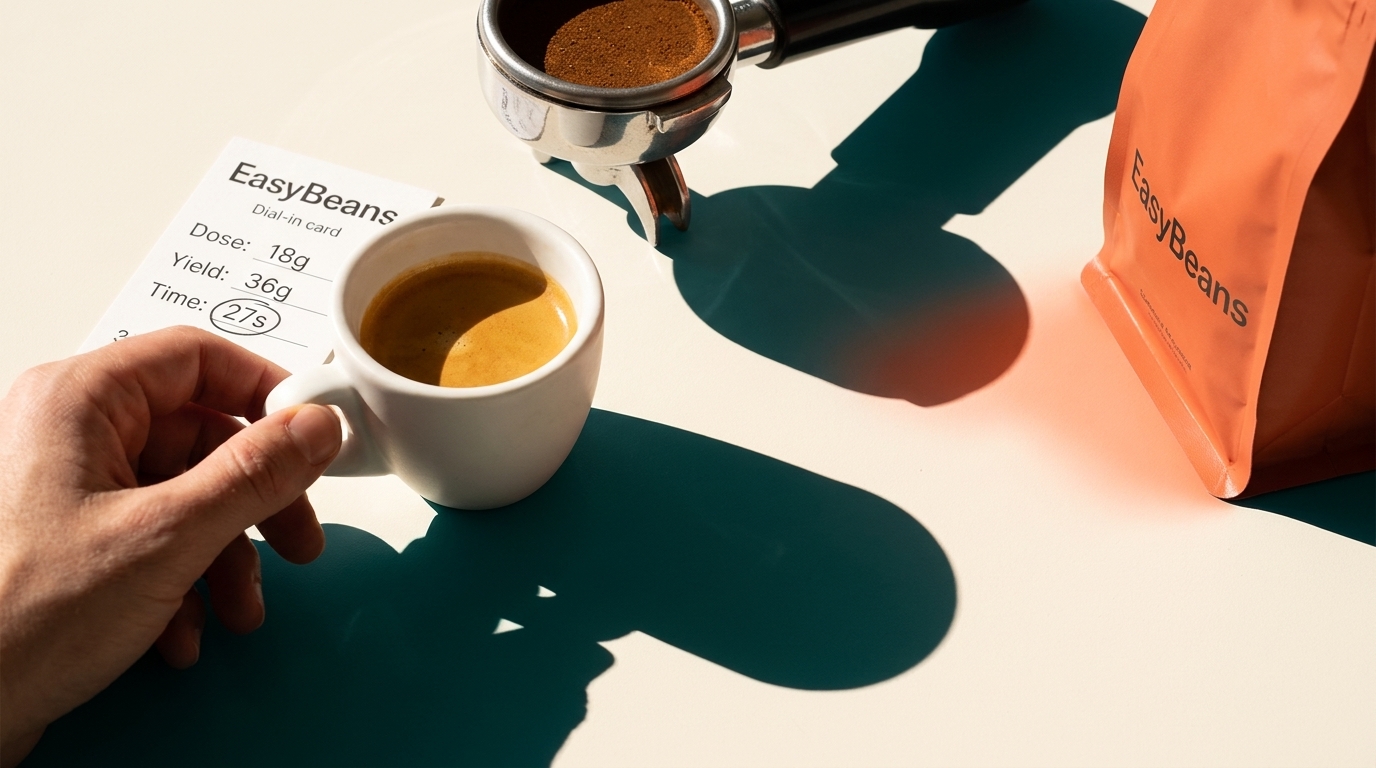
- Follow the recipe that comes with your beans. EasyBeans includes a starting-point recipe: how much coffee, how long the shot runs, which grind size. That starting point saves you the first, most confusing step of the guesswork.
Your first shots won’t be right immediately, and that’s how it should be
Even with the right beans, the first shot rarely comes out right straight away. The grind isn’t set yet, the scale isn’t on yet, the shot runs through in eight seconds or not at all. That happens to everyone starting with a new machine, and it’s not the fault of the beans you chose.
Three to five shots to get to know a new bag is normal. That’s not failure, that’s the process. Forgiving, medium-roasted beans only make that process less painful — the shots that aren’t perfect are still drinkable and not necessarily wasted money.
Don’t switch beans too quickly in this phase. Once you’ve found a good, fresh bean, stick with it until you’ve really got it down. Every new bag is a new learning curve, because the freshness is different and the ideal grind can shift slightly. If you keep switching, you’ll never learn properly whether a disappointing shot is down to the bean or your setting. Stick with the same bean until your shots are reliably good, and only then try something new.
Ready for the next step?
Once you’ve been pulling shots you genuinely like for a few weeks, you’re further along than you think. Here are three logical next steps — choose one instead of all at once:
- Learn to really dial in your shot to taste. Now that you know roughly how a good shot tastes, you can play with grind and time to make it even better for your personal taste. Baristas call this “dialing in.” In the guide to dialing in espresso you can read how that works in practice.
- Try a bean with more character. Now that you know a forgiving single origin, you can try a bean with a more pronounced profile, for example something fruitier or lighter roasted. You’ll taste the subtler flavors the bean has to offer faster, because your reference point is already right.
- Check whether your grinder is the limiting factor. If your shots keep going wrong despite a good bean and a correct recipe, it’s more often the grinder than the machine. Read why in why your grinder matters more than your machine.
What you don’t need to do: immediately buy a more expensive machine. The bean and the recipe already solve nine out of ten beginner problems.
Frequently Asked Questions
Are dark-roasted beans better for an espresso machine?
No, that’s a persistent misconception. Dark-roasted beans aren’t necessarily better for espresso. They’re mostly easier to sell because the flavor is the same everywhere. For a beginner, medium roast works just as easily and tastes more interesting.
As a beginner, should I choose a blend or single origin?
Both work. A blend is composed for a constant flavor — every bag tastes (almost) the same. Single origin comes from one place and varies per harvest, but teaches you to taste what freshness and grinding do faster. Choose a forgiving single origin and you have the best of both worlds.
How many coffee beans should I buy as a beginner?
Start with a 250-gram bag. That’s enough to get used to your machine without the beans going stale before you’re through the bag. Buying a kilo at once is for later, once you know what you like.
How do I recognize fresh coffee beans in the shop?
Look for a roast date on the packaging, not a best-before date. If there’s no roast date, you don’t know how fresh the beans are. That’s usually the case with supermarket coffee. Specialty roasters put the roast date on as standard.
Can I learn with the same coffee beans and still drink good coffee?
Yes. Choose a forgiving bean, medium roast with a wide tolerance, and your shots are drinkable from the first bag, even when the setting isn’t right yet. That’s exactly why forgiving is the best starting point.
What should I do once my shots are finally consistently good?
Then you’re ready for the next layer: learning to dial in to taste more deeply, trying a single origin with a more pronounced profile, or checking whether your grinder is still a limiting factor. Not all at once: choose one.
In closing
Choosing good coffee beans as a beginner comes down to three things: fresh, medium roast, and not too much at once. Brands, origins and flavor notes you discover once that foundation is set.
EasyEspresso, our own single origin from Brazil, is light roasted and yet forgiving for exactly that reason: selected for a wide tolerance window and roasted to protect that window, as described above. Enough character to stay interesting, enough margin to make your first, not-quite-right shots drinkable too. With a starting-point recipe in every bag. See EasyEspresso.
Already bought beans and want to know where to start dialing in? Calculate your starting-point recipe at /startpunt.