Why your grinder matters more than your machine
Most people who start with home espresso do it in this order: buy an expensive machine, add a cheap grinder, use supermarket beans. The result is disappointing and they don’t understand why. The machine is good, isn’t it?
The answer is in the grinder.
The grinder determines what ends up in your cup
Espresso is ninety percent grind size. The machine supplies pressure and water — those are constants. The grinder determines how fine the grounds are, how even the particles are, and therefore how the water flows through the puck.
A good grinder grinds consistently: the particles are all roughly the same size. A bad grinder grinds unevenly and produces a lot of fine dust alongside large chunks. That combination gives channeling — the water takes the path of least resistance through the puck, pulls too fast through the large chunks and leaves the finer parts under-extracted.
The result is a shot that tastes sour and bitter at the same time. That’s not your machine. That’s your grinder.
What a good grinder does
A good grinder does three things a bad one doesn’t:
Consistent particle size. All particles are similar in size. The water flows evenly through the whole puck and extracts the same percentage everywhere.
Few fines. Fine dust, also called fines, clogs the puck and causes over-extraction at a micro level. A good grinder produces few of them.
Adjustable in small steps. When dialing in, you adjust the grind in small steps. A grinder that only makes coarse jumps makes dialing in impossible. You keep overshooting the optimum.
What an expensive machine adds
A more expensive machine gives you better temperature stability, more pressure control and sometimes a pre-infusion option. Those are worthwhile improvements, but only if the grind is already right. Temperature stability helps you nothing at all if the puck itself is already uneven.
The other way around it does work: an average machine with a good grinder gives structurally better results than a top machine with a bad grinder.
The threshold in practice
For home espresso, quality starts somewhere around 150 to 200 euros for a grinder. Not because cheaper grinders can’t do anything, but because below that threshold the consistency of the grind is too variable to dial in reliably.
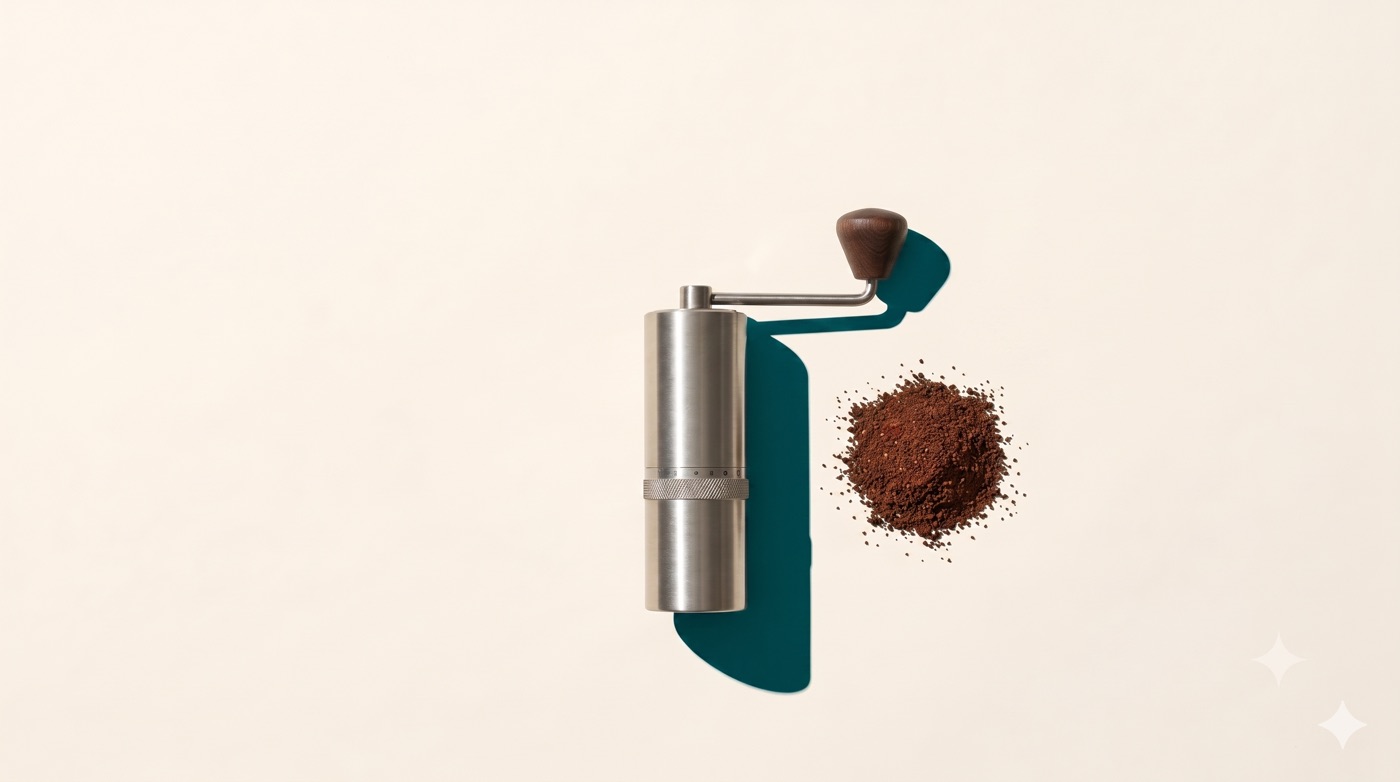
A hand grinder is a serious alternative. For 80 to 150 euros you get a hand grinder that rivals electric grinders costing double in consistency. The only downside is time: grinding a dose takes a minute and a half to two minutes. For the home barista who pulls one or two shots each morning, that’s not a problem.
What this means for your setup
If you have to choose right now between a better grinder and a better machine: choose the grinder. Always.
If you already have a reasonable machine and are unsure where to invest first: the grinder.
If you’re considering starting with espresso and have a budget of 500 euros: spend 250 on an entry-level machine and 250 on a good grinder. Not 450 on the machine and 50 on the grinder.
The recipe at Your starting point is tuned to your grinder, because the grinder is the variable that matters most. Have a good grinder but don’t know how to set it? That’s exactly what dialing in is.
Frequently Asked Questions
Can I still make good espresso with a cheap grinder?
Yes, but the ceiling is lower and dialing in is harder. With a cheap grinder you can learn what espresso is and what the variables do. It just gets harder to consistently make a good shot, because the grind itself varies from dose to dose.
Does the brand of the grinder really matter that much?
The brand less, the quality of the burrs and the adjustment mechanism more. When buying, look at the step size of the adjustment and whether there are reviews about consistency. Price is a rough proxy, but no guarantee.
Does this apply to filter coffee too?
For filter coffee the grinder is also important, but less critical than for espresso. With filter coffee the extraction time is longer and there’s no pressure, so small variations in grind size weigh less heavily. Still, you notice the difference between a good and a bad grinder there too.