The coffee menu explained: every drink and the difference
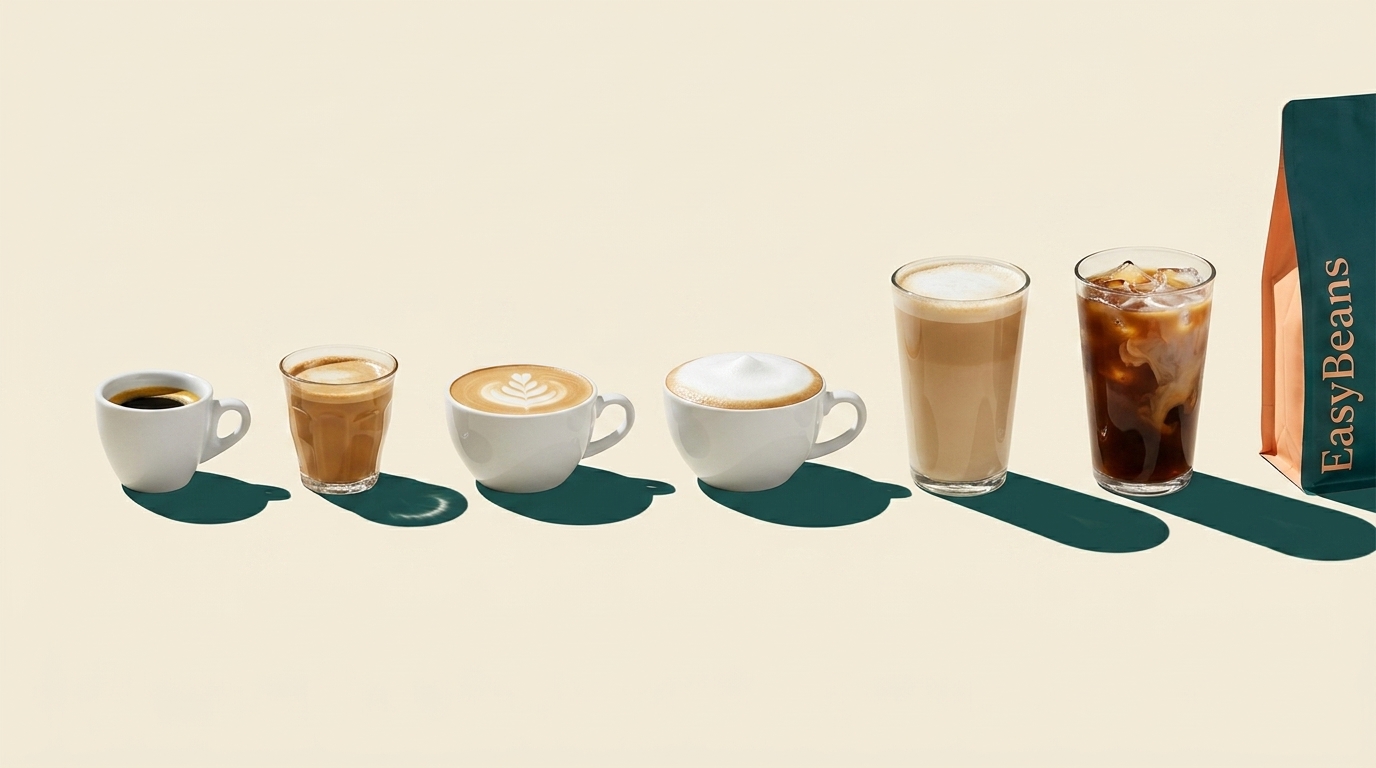
A coffee menu can feel like a test you might fail. Twenty names, half Italian and half English, and the differences are written down nowhere. Below is every drink: where it comes from, what’s in it, and how it differs from the name next to it, down to the variants you’ll only run into at one café in ten. We start with the part that sits underneath almost everything: the espresso shot.
In short
Almost every hot coffee drink in a coffee bar is built from two things: one or two shots of espresso, and whatever you add after that. That can be water, milk, foam, chocolate, ice or a splash of liquor. The amount of milk and the amount of foam decide which name the drink gets. Volume says little about strength: a large latte and a small cortado often contain the same amount of coffee, only the amount of milk differs. On top of that, most menus carry coffee that is brewed without an espresso machine, such as filter coffee, cold brew or Turkish coffee.
How to read a coffee menu
Most menus can be read in two halves. On one side, coffee with espresso as its base. On the other, coffee brewed some other way.
Within the espresso half, two questions decide almost everything: how much milk goes in, and how much foam. An espresso with a spoonful of foam is a macchiato. That same espresso with a full cup of milk in it is a latte. The coffee is the same in these two examples, only the milk-to-coffee ratio makes the name different.
The names come from different traditions. The classics are Italian, such as espresso, cappuccino, latte and macchiato. The cortado is Spanish. Flat white, long black and cold brew come from the English of the modern coffee bar. One comes from the Netherlands: koffie verkeerd, café au lait.
When you order, don’t look only at the size. At most places a large cup means more milk, not more coffee. The number of espresso shots usually stays the same. A large latte is therefore not stronger than a small one.
What is a shot?
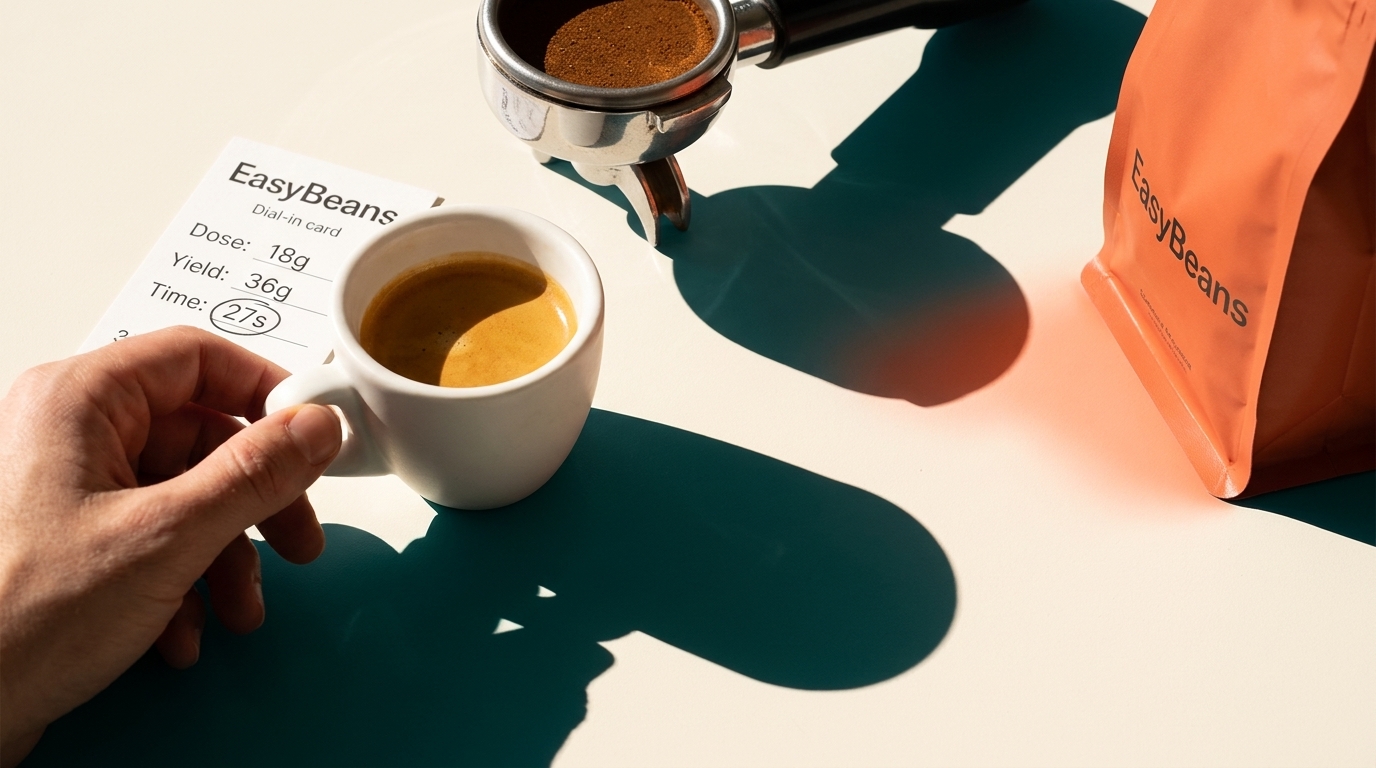
A shot is one espresso. An espresso machine forces hot water at around 93 degrees, under nine bar of pressure, through a bed of finely ground coffee. In 25 to 30 seconds a small, syrupy liquid runs out with a layer of crema on top. That is the shot. Roughly 18 grams of coffee gives about 36 to 40 grams of espresso in the cup, a ratio of 1 to 2.
Almost every hot drink at a coffee bar starts with one or two of those shots. The rest of the menu is variation on what comes after.
The single and the double shot
What the menu simply calls “espresso” usually comes out of a double basket. Twice the dose, twice the yield, the same run time. In coffee jargon that is a doppio.
A real single espresso is made by splitting that double shot across two cups. Not by dosing half the coffee. A small basket with little coffee runs less evenly, and that does the flavour no favours. A single espresso is really nothing more than a double espresso split across two cups.
As soon as milk is involved, a double shot goes in almost every time. Otherwise the coffee flavour disappears under the milk. A flat white with one shot tastes mostly of warm milk. “Double coffee” or “extra shot” on the menu therefore means another double on top. Useful when you want a large latte in which the coffee still stands up.
Ristretto, espresso and lungo: the length of your shot
Besides single or double, you can pull a shot shorter or longer. You use the same coffee and only change how much water runs through it. The ristretto, normal and lungo buttons on a machine do exactly this.
A ristretto stops early, at a ratio of about 1 to 1. The result is a shot of 15 to 20 ml that tastes sweet, thick and almost syrupy, with less bitterness and slightly less caffeine than an espresso. In Naples this is the standard and it is simply called “an espresso”.
An espresso, the “normal” setting, runs to 1 to 2. That is the point with the most balance between sweet, sour and bitter.
A lungo lets more water run through, up to a ratio of 1 to 3 or 1 to 4. You get a larger shot of 50 to 80 ml that tastes thinner and turns bitter faster, because you also pick up the late extraction. Lungos often work better with a darker roasted bean.
Pull the shot longer still and it is called a caffè crema: a ratio of 1 to 5 up to 1 to 8. That is the standard machine coffee in Switzerland and southern Germany. It is often brewed with yet another roast than espresso or lungo.
| Drink | Coffee:water ratio | Volume | Character |
|---|---|---|---|
| Ristretto | 1:1 | 15–20 ml | Thick, sweet, concentrated |
| Espresso | 1:2 | 30–40 ml | The standard, balanced |
| Lungo | 1:3 to 1:4 | 50–80 ml | Longer, thinner, slightly more bitter |
| Caffè crema | 1:5 to 1:8 | 120–200 ml | Large, light, thin crema |
This is not the same as an americano. With a lungo, all the water runs through the coffee under pressure. With an americano you pull a normal shot and add hot water afterwards.
Black coffee with espresso as its base
Espresso. A single espresso shot. 38 to 40 ml in a small porcelain cup.
Doppio. A double espresso. Two shots from one basket. 76 to 80 ml in a porcelain cup. It sometimes does not fit a standard espresso cup, so it comes in a larger one.
Ristretto. An espresso shot, but pulled shorter than a regular espresso. 15 to 20 ml in a small porcelain cup.
Lungo. An espresso shot, but pulled longer than a regular espresso. 50 to 80 ml in a porcelain cup.
Americano. One or two shots topped up with hot water, to taste, somewhere between 1 to 2 and 1 to 4. Pull the espresso first and add the water after, so the crema holds up. With the same bean, an americano tastes clear, lighter and often slightly more bitter than filter coffee.
Long black. The reversed americano from Australia and New Zealand. Hot water in the cup first, then two shots on top. The crema stays intact and the flavour stays closer to espresso.
Red eye. A cup of filter coffee with a shot of espresso in it. Two shots is a black eye, three a dead eye. American, and meant to wake you up.
Espresso corretto. An espresso “corrected” with a splash of liquor, usually grappa, sambuca or cognac. It comes from Italy, and is often something for after a meal.
Espresso con panna. An espresso with a dollop of whipped cream on top. “Con panna” literally means “with cream”.
Café cubano. An espresso you sweeten with raw cane sugar while brewing. That creates a light brown foam layer on top. Strong and sweet at once.
Milk and espresso: from macchiato to latte
This is the big family. Four things decide the drink: the number of shots, the amount of milk, the amount of foam, and the texture of that milk. For texture: the less air you blow in while steaming the milk, the finer and silkier the foam.
Espresso macchiato. An espresso “stained” with a small dollop of milk foam, 35 to 40 ml in total. The coffee is central, the milk only tempers the sharpness.
Cortado. Equal parts espresso and warm milk, 60 to 80 ml together, with barely any foam. The name comes from the Spanish cortar, to cut: the milk cuts the intensity of the espresso. Smaller and more direct than a flat white.
Flat white. Originally a double ristretto with steamed milk and a thin layer of microfoam, these days often just with a double espresso. Around 150 to 160 ml. Smaller than a latte, with a stronger coffee flavour.
Cappuccino. Equal parts espresso, steamed milk and milk foam, 150 to 180 ml together. The thick foam layer is what sets a cappuccino apart. You can order it “dry” for more foam and less milk, or “wet” for the reverse. In Italy a cappuccino is a morning drink and you don’t order it after a meal.
Latte, or caffè latte. A double shot with plenty of steamed milk, 240 to 300 ml, finished with a thin layer of foam. One of the mildest espresso drinks. In Italy, ordering “latte” gets you a glass of milk, so always ask for “caffè latte” there.
Latte macchiato. Here the build is reversed. Warm milk in a tall glass, “stained” with a shot of espresso that visibly sinks through it. Around 180 to 250 ml, with visible layers. Despite the name, this sits closer to a latte than to a macchiato.
Koffie verkeerd (café au lait). The one Dutch drink in this list. Traditionally filter coffee with hot, un-steamed milk, at a ratio of 1 to 2 up to 1 to 3. Many places now serve an espresso version, which is technically almost a latte.
| Drink | Base | Coffee:milk | Volume | Foam |
|---|---|---|---|---|
| Espresso macchiato | 1 shot | stain of milk | 35–40 ml | small dollop |
| Cortado | 1–2 shots | 1:1 | 60–80 ml | barely any |
| Piccolo | 1 ristretto | ~1:2 | 90–100 ml | thin layer |
| Flat white | 2 shots | ~1:3 | 150–160 ml | microfoam |
| Cappuccino | 1–2 shots | ~1:2 plus foam | 150–180 ml | thick layer |
| Latte | 2 shots | 1:5 to 1:8 | 240–300 ml | thin layer |
| Latte macchiato | 1 shot | milk with a shot of espresso | 180–250 ml | layered |
| Koffie verkeerd | filter coffee | 1:2 to 1:3 | 150–200 ml | none |
The four names that get mixed up most often, macchiato, cortado, koffie verkeerd and latte macchiato, are set side by side in Macchiato, cortado, café au lait or latte macchiato: the difference.
The small and regional milk drinks
These names vary a lot from city to city and café to café. The ratios below are a guideline. Every local barista makes them a little differently.
Piccolo, or piccolo latte. A single ristretto with a small layer of steamed milk in a roughly 100 ml glass. Australian. For those who want the coffee of a flat white in a smaller format.
Gibraltar. Effectively a cortado, named after the Libbey glass that coffee bars in San Francisco started serving it in. Same drink, different name.
Cortadito. The Cuban cortado. Equal parts espresso and steamed milk, sweetened, often with sugar whipped into the milk and added during the pull.
Café breve. A latte made with a blend of milk and cream instead of just milk. American, richer and heavier.
Café bombón. Espresso with an equal amount of sweetened condensed milk, poured into a small glass so you see the two layers. From Valencia.
Marocchino. A small glass with espresso, cocoa powder and a layer of milk foam. In some regions it is called a mocchino or a mocaccino.
Bicerin. A speciality from Turin. Espresso, hot chocolate and milk or cream, poured in layers in a glass and not stirred.
Wiener Melange. The Viennese cousin of the cappuccino. Coffee with steamed milk and foam, sometimes topped with whipped cream.
Chocolate and flavoured coffee
Mocha, also caffè mocha or mochaccino. Espresso with chocolate, usually hot chocolate milk or chocolate syrup, topped up with steamed milk. It comes down to a latte with chocolate added.
Flavoured lattes. Vanilla, caramel, hazelnut or pumpkin spice: a latte with a pump of syrup in it. The coffee base here is just espresso with milk.
Caramel macchiato. Despite the name, this is not a macchiato in the classic sense. It is a vanilla latte with caramel sauce, originally a Starbucks brand name.
Chai latte, matcha latte, London Fog. Often on the coffee menu, but they contain no coffee. It is steamed milk with, respectively, chai tea, matcha powder or Earl Grey.
Cold coffee
Iced coffee is a catch-all term. Usually one or two shots of espresso or a portion of filter coffee, poured cold over ice, with or without milk.
Iced latte and iced americano. The hot version, straight onto ice and cold milk or cold water. Quick to make, though the flavour waters down as the ice melts.
Cold brew. Coarsely ground coffee steeped in cold water for 12 to 24 hours. Low acidity, low bitterness, naturally sweet and soft. You brew it concentrated and then dilute it with water or milk.
Nitro cold brew. Cold brew poured under pressure with nitrogen, like stout from a tap. The result: a creamy mouthfeel, a nice foam head, and usually no ice.
Flash brew, also Japanese iced coffee. Hot-brewed filter coffee that runs straight onto ice. The quick cooling locks in the fruity, aromatic side that cold brew loses.
Cold drip, also Kyoto style. Cold water that drips through the coffee drop by drop for hours. Intense and almost syrupy in flavour.
Espresso tonic. A shot over tonic and ice. Bittersweet and fizzy, and more popular every summer.
Shakerato. An espresso with ice and sugar, shaken hard until a foam layer forms, then poured without the ice. A true Italian coffee speciality.
Freddo espresso and freddo cappuccino. The Greek cold standard. You foam the espresso cold with a hand blender. The freddo cappuccino gets a layer of cold milk foam on top.
Mazagran. Cold coffee with lemon and sometimes a splash of rum. A Portuguese coffee speciality with a story that goes back to the 19th-century war between France and Algeria. During that war, French soldiers drank lemonade to stay hydrated, and coffee was added later.
Affogato. Strictly speaking a dessert. A scoop of vanilla ice cream with a hot shot of espresso poured over it, served immediately.
Frappé. Greek iced coffee made from instant coffee, water and sugar, shaken with ice into a foam. The Starbucks Frappuccino is a blended version of this with ice and milk.
Coffee without an espresso machine
Filter coffee, also house coffee or batch brew. Coffee that runs through a paper or metal filter on gravity alone. Milder than espresso, with more clear flavour nuances and less bitterness.
Slow coffee or pour-over. Filter coffee you pour by hand, usually in a V60, Chemex or Kalita. Same principle, but with more control and handwork, brewed cup by cup.
Cafetière, also French press. Coffee steeped in a jug where you press the grounds down with a mesh plunger. Full and round, with some sediment in the cup.
AeroPress. Coffee you press through a small filter with light hand pressure. Fast, clear in flavour and one cup at a time.
Turkish and Greek coffee. Extremely finely ground coffee that you bring almost to the boil with water and sometimes sugar in a cezve. You serve it unfiltered, with a foam layer on top and a layer of grounds at the bottom that you leave behind.
Moka pot, also percolator. The octagonal stovetop pot. Steam pressure forces the water up through the coffee. Stronger than filter coffee, but not as concentrated as real espresso.
What you still choose yourself: milk, size and sweetness
Plant-based milk. Oat, soy, almond or coconut. Oat and soy steam the most stably and come closest to the texture of cow’s milk. For home, buy a barista version at least, since that one is made to foam.
Cup size. Small, medium or large means more milk at most places, not more coffee. The number of shots usually stays the same until you explicitly ask for an extra one. A large latte is therefore not stronger, only milder and larger.
Sugar and syrup. They change the sweetness, not the strength.
Decaf. Possible on any drink on the coffee menu. The beans are decaffeinated beforehand, the preparation stays the same.
Not sure? Ask the barista
A coffee menu is a starting point, not an exam. If you’re torn between two names, or you want something that isn’t quite listed, just ask. A good barista enjoys thinking along with you.
Say what you’re after in plain words. “Something with a lot of milk and not bitter.” “As strong as possible in a small cup.” “Cold, but not sweet.” A barista can pick a drink to match that, even if it doesn’t have a name.
Useful things to mention:
- How much milk you want, somewhere between black and mostly milk.
- Whether you like bitter, or prefer bright and sour.
- Which bean is on. Many places have one espresso for milk drinks and a lighter bean for filter coffee, and can tell you what’s running well that day.
- Whether you want caffeine or not.
If you order something and it isn’t what you expected, say so too. The next cup gets better for it.
Frequently Asked Questions
What’s the difference between a single and a double shot?
A single shot uses about 9 grams of coffee, a double twice that. In practice, almost every café works with the double, even when the menu just says “espresso”. A real single is made by splitting a double shot across two cups. For milk drinks a double goes in by default, otherwise the coffee disappears under the milk.
What do ristretto, normal and lungo mean on my machine?
Those settings decide how much water runs through the same amount of coffee. Ristretto stops early, so less water, giving a thick and sweet shot. Normal is the standard espresso at a ratio of 1 to 2. Lungo lets more water run through, which gives a larger but thinner and often slightly bitter shot.
What’s the difference between a latte, a cappuccino and a flat white?
All three are espresso with steamed milk. A cappuccino has a thick foam layer and stays around 150 to 180 ml. A latte has more milk, barely any foam and is larger, up to 300 ml. A flat white sits in between on size, but has the strongest coffee flavour, with two shots and only a thin layer of microfoam.
Is an americano the same as filter coffee?
No. An americano is espresso topped up with hot water, brewed under nine bar of pressure. Filter coffee runs through a filter on gravity alone, with much more water and a longer contact time. With the same bean, filter coffee tastes clearer and less bitter.
I don’t like bitter coffee. What can I order?
Ask for filter coffee, a flat white or a cortado, and mention that you want to avoid bitterness. Filter coffee is naturally less bitter than espresso. If cold is fine too, cold brew is the softest option. Avoid lungo and caffè crema, since those draw out the bitter late extraction.
What’s the strongest coffee on the menu?
For pure intensity in a small cup: a ristretto or a double espresso. For the most caffeine: two double shots, for instance as an americano or in a large latte with an extra shot. A large mug of filter coffee often contains as much caffeine as a double espresso, but you drink it more slowly.
Sources
- James Hoffmann, The World Atlas of Coffee, second edition, 2018. Definitions and ratios of espresso drinks.
- Specialty Coffee Association (SCA), sca.coffee. Standards around espresso, extraction and milk.
- Perfect Daily Grind, perfectdailygrind.com. Background on regional drinks and their origins.
- Barista Hustle, baristahustle.com. On shot length, brew ratio and the influence of milk.
In closing
The coffee menu is long, but the logic is short. Under almost every name sits a shot of espresso, plus a choice about milk and foam. Once you can gauge those two things, you can read almost any menu without guessing.
Want to see the four drinks that get mixed up most often? Read Macchiato, cortado, café au lait or latte macchiato: the difference. Want to learn to make them yourself? Start with Becoming a home barista.
No starting point for your espresso yet? Calculate your recipe at /startpunt →