Why freshly roasted coffee tastes like ash: the science of degassing
This article is part of the ultimate guide to specialty coffee at home — here it’s about the rest time between roasting and brewing.
In the world of food, freshness is sacred. Yesterday’s croissant is inferior to this morning’s. Conditioned by that, many consumers demand coffee beans straight from the roaster’s cooler. With specialty coffee, though, that’s a fundamental mistake.
Coffee roasted yesterday is chemically unstable and genuinely difficult for the home barista. The culprit: an overdose of carbon dioxide (CO2).
The chemistry of roasting and CO2 formation
During roasting, the hard, green coffee bean goes through extreme heat, often climbing past 200°C. Inside the bean, an explosion of chemical reactions takes place, including the Maillard reaction — the caramelization of sugars and amino acids — and the breakdown of organic acids.
An unavoidable by-product of these processes is the mass production of gases, primarily CO2. Although some of this gas escapes during first crack, a substantial amount of CO2 stays trapped in the dense, microscopic cell structure of the roasted bean.
CO2 as the enemy of extraction
When you brew coffee, you want water to penetrate the bean’s cells to dissolve flavor compounds. CO2 creates a double problem here.
Hydraulic blockage. As soon as hot water contacts the grounds, the trapped CO2 gas expands instantly — this is the ‘bloom’ you see with filter coffee. With espresso, which happens under pressure in a closed basket, this gas has nowhere to go. It forms physical barriers around the coffee particles, the water is repelled, and you get unpredictable channeling and heavy under-extraction: a thin, sour shot with an absurdly thick, pale crema that dissolves within seconds.
Carbonic acid formation. Too much dissolved CO2 in water creates volatile carbonic acid. This gives the coffee a sharp, metallic, ashy bitterness in the finish that masks all the delicate floral and fruity notes of a specialty roast.
The degassing protocol: time as an ingredient
To extract the coffee properly, the gas has to escape. That’s why specialty roasters pack their beans in bags with a one-way valve: oxygen — which oxidizes coffee and makes it stale — can’t get in, but CO2 can safely get out.
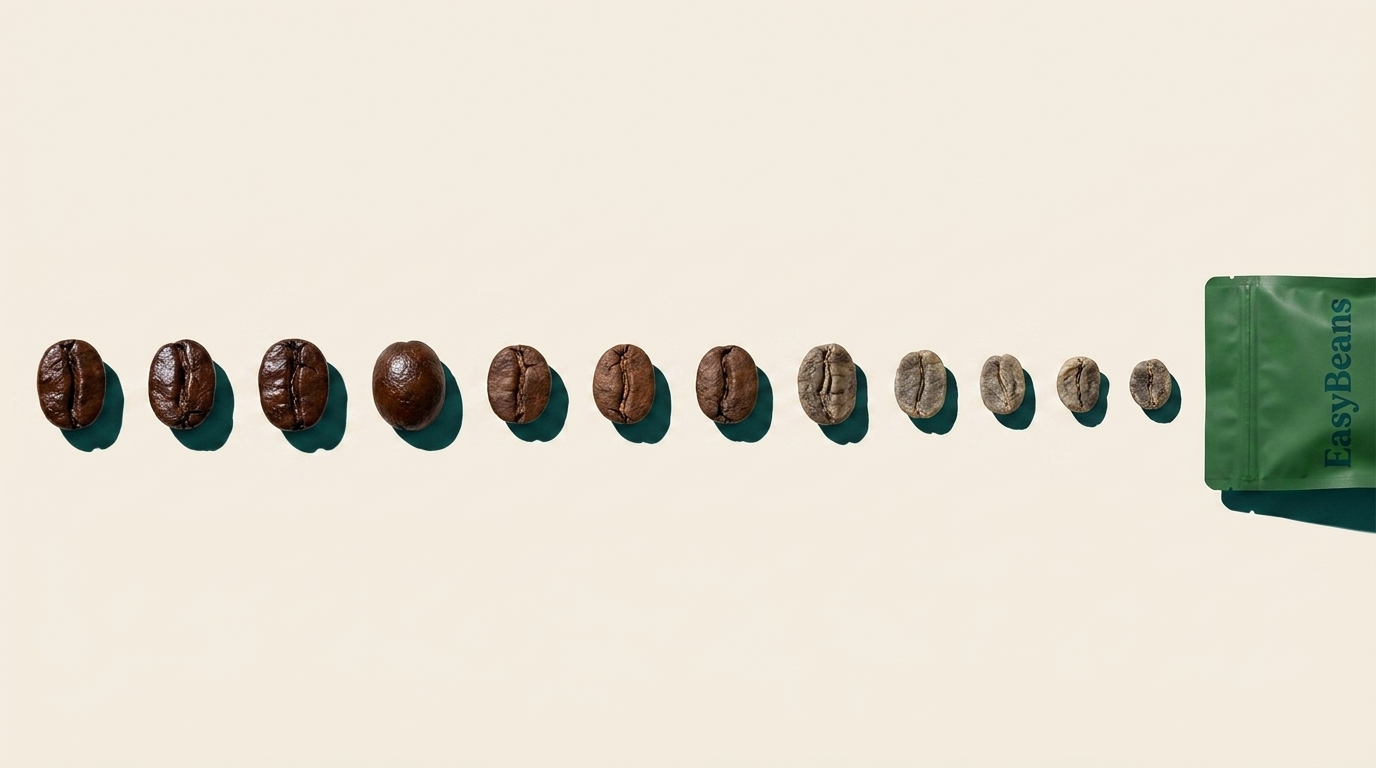
The speed of degassing depends on the roast level and the density of the bean. Use the following rest times before you open a bag:
- Dark roasts (traditional): darker-roasted beans are more porous and their structure is more broken down. They degas quickly. Ideal rest time: 5 to 7 days.
- Espresso (medium-light specialty roasts): the cells are intact and density is high. The gas leaves the bean agonizingly slowly. Ideal rest time: at least 10 to 14 days. These coffees often peak in flavor balance between week 3 and week 6 after the roast date.
- Filter coffee (ultra-light roasts): extremely dense beans. Ideal rest time: at least 7 to 10 days. The clarity in the cup often only becomes truly spectacular after 3 weeks.
Frequently Asked Questions
How long should coffee rest after roasting?
It depends on the roast level: 5 to 7 days for dark roasts, at least 10 to 14 days for espresso-focused medium-light roasts, and 7 to 10 days for ultra-light filter coffee — with a peak in flavor often only after 3 weeks.
What exactly is the ‘bloom’ with filter coffee?
The bloom is the visible swelling of the coffee bed as soon as you pour hot water onto it. That’s the trapped CO2 gas escaping all at once. The fresher the coffee, the more intense the bloom.
Can coffee also rest too long?
Yes. Once nearly all the CO2 has escaped, the coffee also gradually loses aroma through oxidation. For most specialty roasts, the peak is somewhere between 3 and 6 weeks after roasting, depending on roast level and packaging.
Why is my espresso sour and watery when the beans are freshly roasted?
Too much CO2 blocks an even extraction: the water is literally repelled by the gas, so the shot under-extracts. Give the beans more rest time and test again.
In closing
Freshness in coffee isn’t a matter of brewing as soon as possible after roasting — it’s a matter of choosing the right moment. Rest time isn’t waiting time, it’s part of the recipe.
Find the starting-point recipe for your setup here →
See also: The ultimate guide to specialty coffee at home · How old can coffee beans be?