Descaling your espresso machine: how and how often
The descale light is on. Or worse: it’s not on, but your shot suddenly tastes different from last week — flatter, slower, as if the machine isn’t quite cooperating anymore.
That’s almost never the beans. That’s scale.
Descaling isn’t a maintenance ritual for show. It’s the foundation under a stable temperature — and without a stable temperature, no grind setting works consistently. Here’s what scale does, how often to descale, and the step-by-step process.
What limescale does to your machine
Scale is calcium carbonate — a mineral in water that precipitates as soon as water evaporates or is heated. That deposit attaches to heating elements, boiler and lines.
Three things happen as a result:
- Your heating element insulates. Scale conducts heat poorly. The thicker the layer, the more power it takes to bring water up to temperature. Your water temperature also becomes less stable — and you taste that back in the shot.
- Your lines narrow. Water flow decreases, the pump has to work harder to get the same result.
- Parts wear faster. Over time, scale build-up damages the heating element and pump beyond repair.
None of this happens in a day. It stacks up, until the light comes on or the shot points it out.
How often to descale?
The frequency doesn’t depend on your machine — it depends on your water. Water hardness varies strongly by region. Some areas have very hard water; others are milder.
| Water hardness | Frequency |
|---|---|
| Very hard (>20°dH) | Every 1–2 months |
| Medium (10–20°dH) | Every 2–3 months |
| Soft (<10°dH) | Every 3–6 months |
Want to know exactly where you sit? Request a water analysis from your water company, or use a test strip. And beyond that, always follow your machine’s built-in signal — it often measures based on water volume, not the calendar.
Descaling your espresso machine in 5 steps
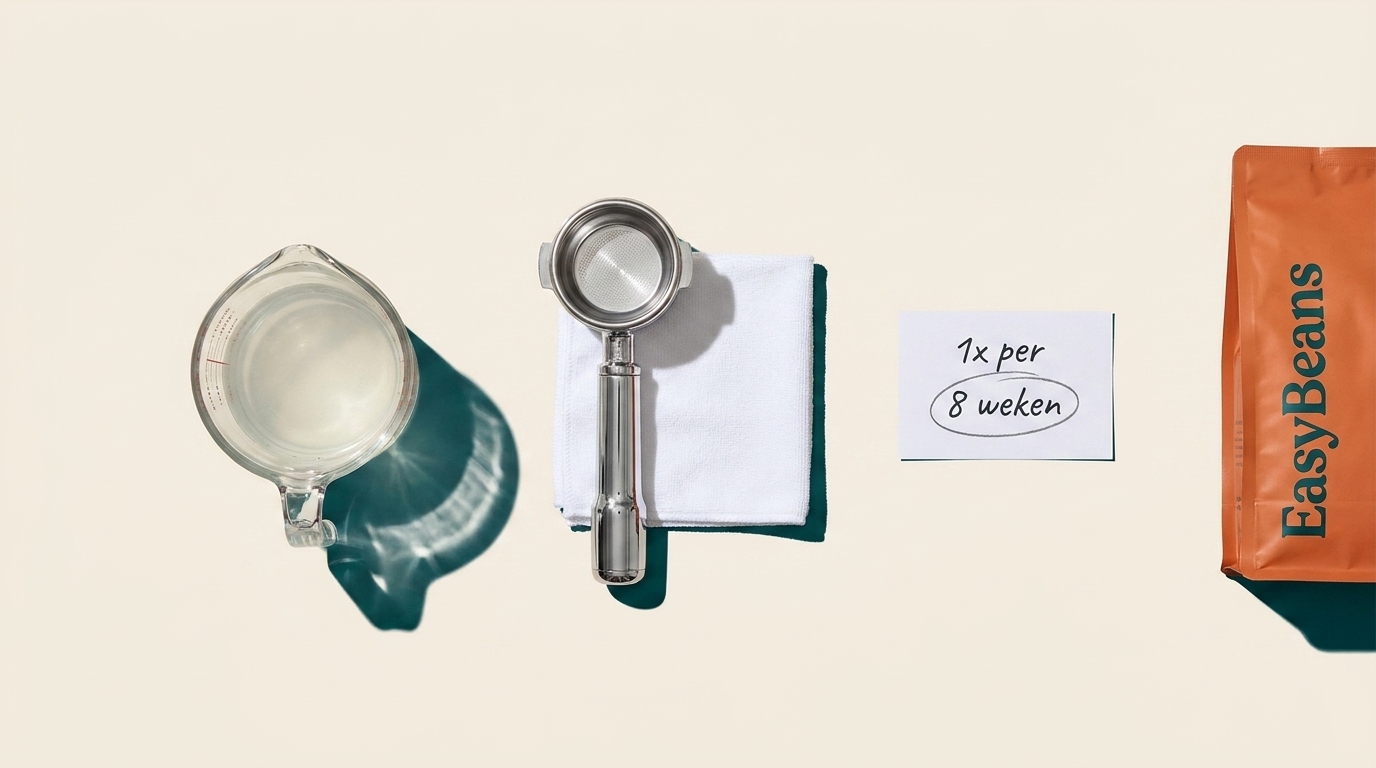
Choose your agent. Citric acid is cheap, odorless and the most common choice. A dedicated descaling product works just as well. Vinegar can work, but it leaves a smell and aftertaste that are hard to rinse out completely, and it’s more aggressive on rubber seals.
Dissolve according to the ratio. Check the packaging or the machine manual. More concentrated isn’t more effective — it’s just harder on the seals.
Run the descale program. If your machine has one: use it. No program? Let the mixture sit for 10 to 15 minutes without heating.
Rinse at least 2 to 3 times with clean water. This is the step most often rushed. You’ll taste descaler residue in your next shot right away — and that’s not the “clean” feeling you’re after.
Pull a blank shot. Without coffee, purely to check that the flavor is neutral again before you carry on.
Descale light stays on — now what?
The reset procedure varies by brand, but usually comes down to: holding the descale button for a few seconds after rinsing, not before. If that doesn’t work, check the exact reset command in your machine’s manual — it varies too much by model to give one rule here.
Prevention is better: water softening
A water softener or filtered water lowers the descale frequency considerably — less scale going in means less scale to rinse out. Which type fits best depends on your machine and your water hardness; that’s different for every situation.
Frequently Asked Questions
Can I use vinegar instead of descaler?
It works, but it leaves an aftertaste that’s hard to rinse out completely. Citric acid is the neutral, cheap preferred option.
What happens if I never descale?
Over time, irreparable damage to the heating element and pump, higher electricity costs, and a less stable shot temperature — exactly the variable you want under control when dialing in your espresso.
My machine is new but already asking to be descaled — is that normal?
Yes. Frequency depends on water hardness and usage volume, not on age. With hard water and heavy use, this can come up after just six weeks.
How do I know how hard my water is?
Request a water analysis from your water company (by postal area) or use a test strip.
In closing
Descaling isn’t show maintenance. It’s the foundation under a stable shot temperature — without it, no grind setting works consistently.
Once you have temperature and maintenance under control, the next step is getting the shot itself right: dialing in espresso — the complete guide.
Find the starting-point recipe for your setup here →
See also: Dialing in espresso: the complete guide