Flat vs. conical burrs: what do you actually taste?
This article is part of the ultimate guide to specialty coffee at home — here we zoom in on the grinder itself.
When home baristas want to take their extraction to a higher level, the focus often goes to the espresso machine. The hard reality, though, is that the machine is just a kettle with a pump. The real alchemy happens in the grinder.
The way a coffee bean is broken into thousands of particles determines nearly all of your extraction potential. In the world of high-end coffee grinders, the debate is about the geometry of the burrs: flat versus conical. This isn’t an aesthetic choice — it’s a choice in physics and flavor profile.
The science of particle size distribution (PSD)
To understand the impact of burrs, you have to look at the Particle Size Distribution (PSD). No grinder in the world grinds every particle exactly the same size. You always get your target size (the ‘boulders’ or target grind), but also microscopically small dust particles (the ‘fines’). Fines have a relatively huge surface area and therefore extract almost instantly once water hits them.
Conical burrs: bimodal extraction and body
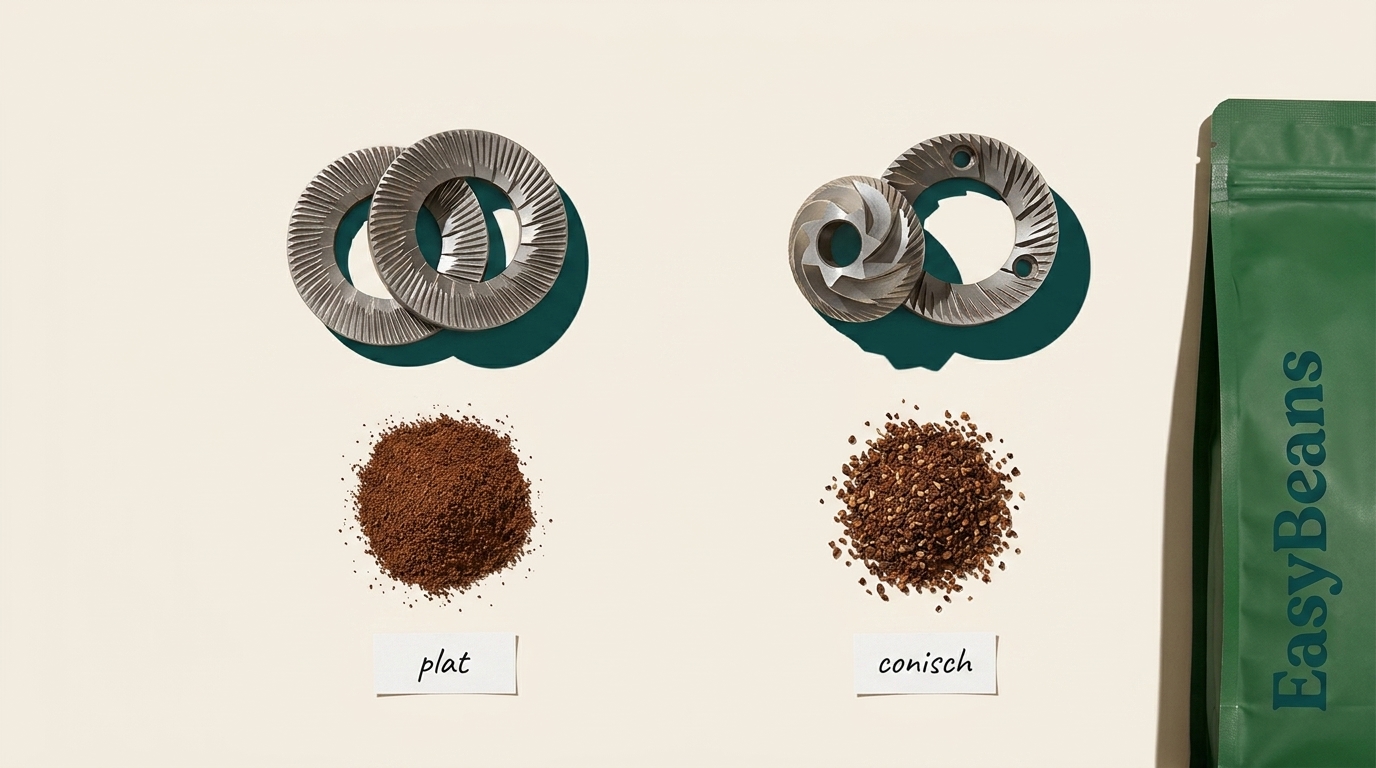
A conical grinder consists of a stationary serrated outer ring and a rotating, cone-shaped inner ring. The beans fall down by gravity and are crushed further and further by the teeth.
Conical burrs naturally produce a bimodal particle distribution — two distinct peaks in particle size: a large group of fines and a group of coarser particles. Because the fines extract extremely fast, they bring heavy, bitter and syrupy components straight into the cup. The coarser particles extract more slowly and deliver the acids and sugars.
The result: conical grinders blend flavors into each other. They produce a classic, heavy, syrupy body and an intense mouthfeel. They’re extremely forgiving during dialing in and perfect for medium to dark roasts and milk drinks.
Flat burrs: unimodal clarity and separation
A flat grinder has two parallel discs. The beans fall in the center and are flung outward by centrifugal force through a series of ever-smaller cutting teeth.
Flat burrs ‘cut’ the bean more efficiently and produce a much more unimodal particle distribution: nearly all coffee particles are exactly the same size, with drastically fewer fines. Because all particles are the same size, they all extract at the same speed — barely any over-extracted fines or under-extracted boulders.
This results in extreme clarity and flavor separation. In a good Ethiopian coffee you suddenly taste the jasmine, separated from the peach. The acids are sparkling and precise, though the mouthfeel often gives up a little syrupiness. Ideal for complex light roasts and modern specialty espresso and filter coffee.
Which grinder fits your coffee?
Choose your grinder based on the coffee you drink. Do you drink exclusive, light-roasted single origins where you want to pick apart the original terroir? Large flat burrs (64mm or larger) show that best. Are you looking for a thick, forgiving espresso with notes of hazelnut and chocolate? A high-quality conical grinder is your weapon.
Frequently Asked Questions
Which burr is better for espresso: flat or conical?
Neither is objectively better — it depends on your beans and your taste preference. Flat burrs give more clarity and flavor separation, ideal for light, complex single origins. Conical burrs give more body and a forgiving, syrupy espresso, ideal for medium to dark roasts.
What is Particle Size Distribution (PSD) and why does it matter?
PSD describes how evenly a grinder grinds the coffee particles. The more unimodal (even) the distribution, the more consistent the extraction speed of all your coffee — and the lower the chance of a shot that tastes sour and bitter at the same time.
Are flat burrs always better for light roasts?
Usually, yes, because the unimodal distribution brings out the subtle acids and aromas of a light roast better. But a well-aligned conical grinder can also work excellently — the quality and alignment of the burrs weigh more heavily than geometry alone.
Should I trade my conical grinder for a flat one?
Not necessarily. Only upgrade once you know what you’re missing in your current cup — not as a first investment. A well-aligned conical grinder still delivers better coffee than a mediocre flat one.
In closing
The geometry of your burrs isn’t an aesthetic choice, but a choice in physics that works straight through into your cup. Once you know which beans you brew most often, you also know which grinder fits.
Find the starting-point recipe for your setup here →
See also: The ultimate guide to specialty coffee at home · WDT, RDT and puck prep: fluid dynamics in your portafilter