Learning to taste coffee: the ultimate guide
Judgments about coffee often get stuck at “nice” or “not nice.” Those are conclusions, but they don’t tell you how you got there. You are tasting something specific — you just may not have the right words for it yet.
This guide hands you those words. Not as jargon to show off, but as practical tools. If you can name what you taste, you can also choose a coffee bean, brew method and recipe that fit your taste much more deliberately.
We cover four topics. First we look at what you actually taste and smell. Then you learn how to recognize flavors systematically. Next you discover how the brew method determines what ends up in your cup. Finally we explain why the bean itself has already fixed a large part of the flavor, before you even brew it.
What you actually taste
Most of what we call flavor, we actually experience with our nose. Your tongue can only distinguish five basic tastes: sweet, sour, bitter, salty and umami. The rest of the experience comes from aroma.
Aroma determines 70 to 80 percent of your flavor experience. This happens not only by smelling your cup directly, but mostly through retronasal smell. Those are scent molecules that rise from your mouth cavity to your nose during swallowing. Coffee contains more than 800 of these volatile aroma compounds. This explains why freshly ground coffee smells so promising. An hour later the most interesting aromas have already evaporated.
Of the five basic tastes, three play a leading role in coffee:
- Acidity is the lively, fresh note you also taste in ripe fruit. Within specialty coffee this is a mark of quality and certainly not a fault. A sharp or harsh sourness, on the other hand, is a problem and often points to under-extraction.
- Bitterness belongs in coffee in a limited amount and gives depth to the flavor. If the bitterness dominates and leaves a dry feeling, that’s often a sign of over-extraction or too dark a roast.
- Sweetness doesn’t refer to added sugar. It’s the natural sweetness that develops when a coffee cherry was fully ripe at harvest.
You also taste body. This isn’t a flavor, but a texture. It describes the mouthfeel of the coffee, which can range from watery to velvety. Body is largely determined by your brew method, which we come to later.
How to learn to recognize flavor systematically
Without a clear approach, tasting often stays at a general judgment. With a structured method, it becomes a skill you can develop.
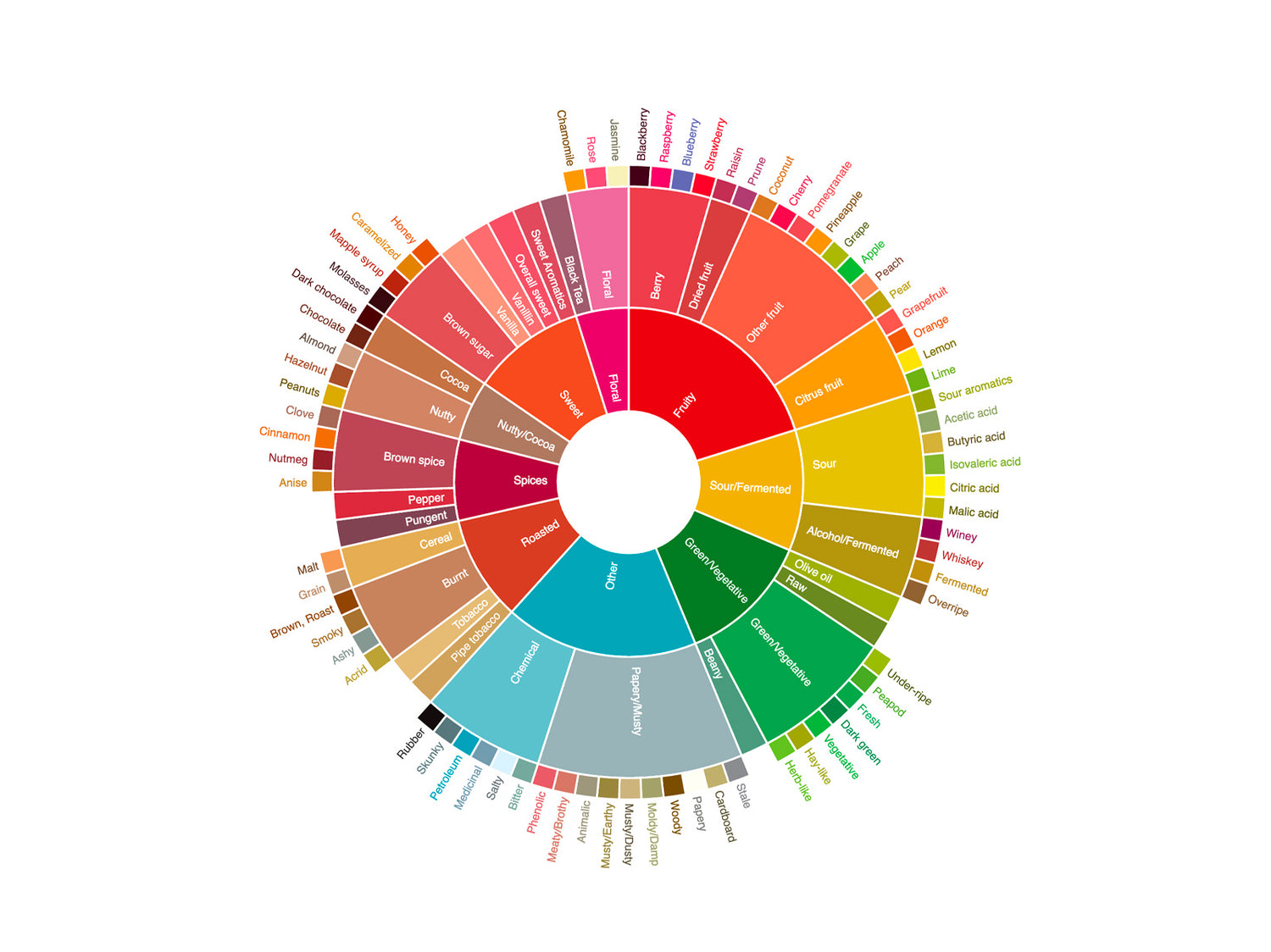
The flavor wheel is the most important tool for this. The Specialty Coffee Association (SCA) developed it in 2016 as a universal language for coffee tasters. The wheel contains more than 110 flavor descriptions and is organized from general (in the center) to specific (in the outer ring). You work from the inside out. Do you taste something fruity, for example? Then decide whether it’s citrus, a berry or stone fruit. That way you refine a vague feeling step by step into a concrete word.
Besides specific flavor notes, professionals also use a number of tasting attributes to assess overall quality:
- Balance: Do sour, sweet, bitter and body complement each other, or does one component dominate in an unpleasant way?
- Complexity: Do multiple layers of flavor unfold one after another, or does the experience stay flat and one-dimensional?
- Clean cup: Is the coffee free of off-flavors, like musty, chemical or earthy, that cloud the clarity?
- Uniformity: Does every cup of exactly the same coffee actually taste the same?
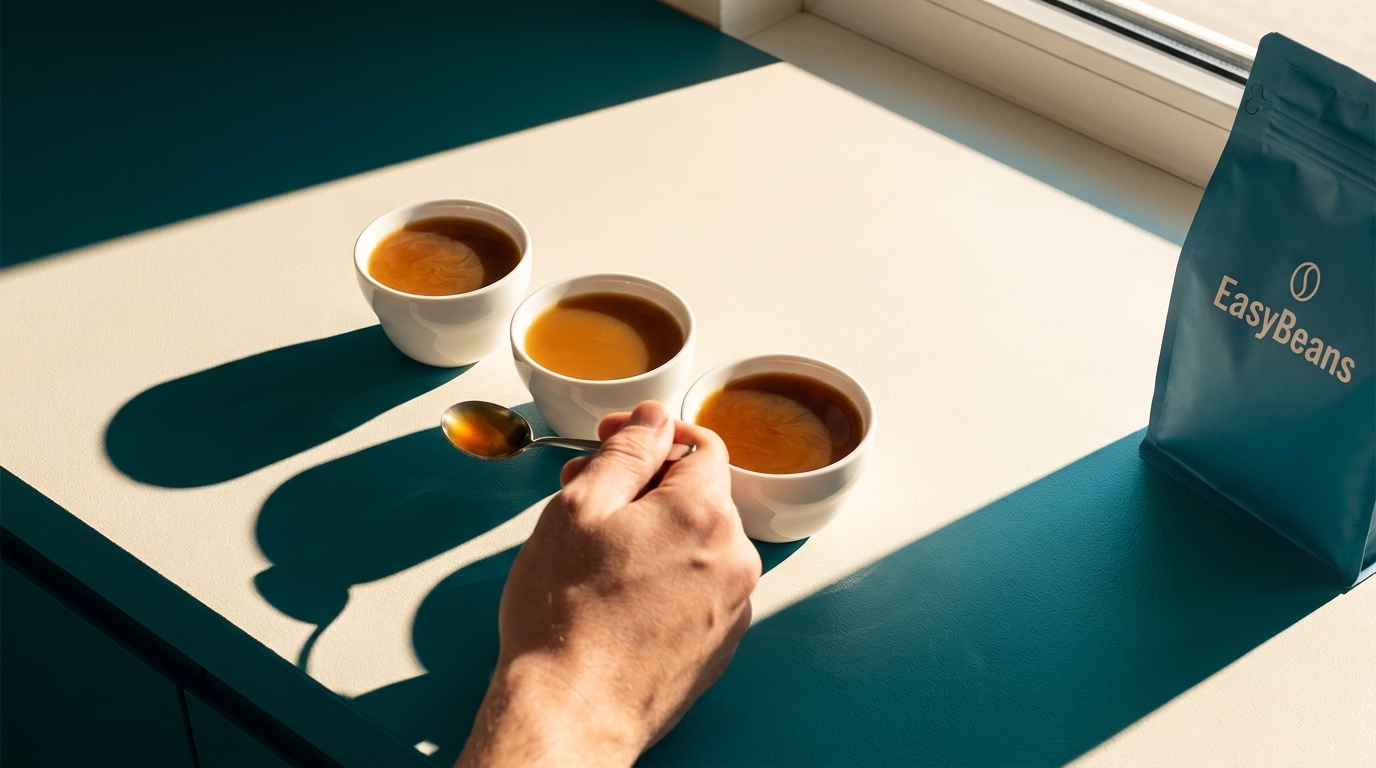
This may sound technical, but you can apply it easily at your own kitchen table. Put two cups of the same coffee side by side and ask yourself: do they taste identical (uniformity)? Does something dominate (balance)? Do I taste more than one flavor (complexity)?
Want to practice this in a structured way? The cupping protocol is the standardized tasting method professionals use. It’s the fastest way to learn this at home, because the brew method isn’t a distracting factor then. We cover this in detail in the article Cupping at home: learn to taste coffee like a professional.
The brew method determines what you taste
The same coffee bean can taste very different per brew method. The bean itself doesn’t change, but every method pulls out different compounds from the ground coffee and holds others back.
The effect on body is the clearest example. A French press uses a metal filter, so oils and fats end up in your cup. This delivers a heavy, full body. A paper filter, like in a V60 or Chemex, holds these oils back. The result is a clearer mouthfeel and less weight. Espresso has a very intense, heavy body due to the high pressure and concentration. Cold brew, despite the low temperature, also has a surprisingly full body.
There’s no ‘best’ method. The question is mostly which properties of the bean you want to emphasize. The clarity and subtle acids of a light-roasted Ethiopian bean come out perfectly in a V60, for example. A bean with lots of body and little acidity, like a Sumatra, loses little character in a French press and even gains body.
Which method fits a particular flavor profile best, we explain in detail in the article How the brew method affects the flavor of your coffee.
Which bean fits which flavor?
Long before the water hits the coffee, the bean itself has already been given a certain flavor direction. The coffee variety is an important factor here, comparable to grape varieties in wine.
A few examples: Bourbon is known for its sweetness and the complex flavors of red fruit. Gesha is exceptionally aromatic, with notes of jasmine, bergamot and black tea, which also makes it very pricey. The Kenyan varieties SL28 and SL34 deliver a pronounced acidity and intense berry notes. Typica is more delicate and forms the genetic basis for many other varieties.
The origin of the bean is a second, more general rule of thumb. Coffee from countries like Ethiopia and Kenya typically has a pronounced acidity with floral or fruity notes. Coffee from Brazil and Sumatra generally has less acidity and a heavier body, with round flavors of nuts and chocolate.
This isn’t an exact science, of course. The variety, the terroir, the processing and the roast together determine the final flavor. Still, it’s an excellent starting point if you’re looking for a specific taste preference.
The full connection between bean and flavor, including a handy chooser, is in the article The flavor of coffee beans: what to look for.
Why the bean already carries flavor: terroir and processing
Two beans of exactly the same variety can still taste completely different. This is due to the conditions they grew in and the way they were processed, before they’re even roasted.
The growing altitude is a decisive factor here. At high altitudes, nights cool down more sharply. This makes the coffee cherry ripen more slowly and gives the plant more time to develop complex sugars and acids. Above 1500 meters this yields compact, complex beans with a clear acidity. Below 800 meters you get softer, rounder beans with considerably less acidity and complexity.
The concept of terroir covers even more factors, like the climate, the soil composition and the local microclimate. A volcanic soil, specific rainfall patterns and the amount of shade all influence how the cherry ripens and which flavors develop. This explains why an Ethiopian and a Colombian coffee of the same variety can still taste incomparable.
Finally, the processing method is a third, often underestimated factor:
- Washed process: the fruit pulp is fully washed off the bean before it’s dried. This results in a clear, clean flavor with a distinct acidity. The pure flavor of the bean comes forward, without influence from the fruit pulp.
- Natural process (unwashed): the whole coffee cherry is dried intact, with the bean still in it. This gives a fruity and sweet profile with a full body, that sometimes even recalls wine.
- Honey process: part of the sticky fruit pulp (mucilage) stays on the bean during drying. In flavor this sits right between washed and natural. The more pulp left on, the sweeter and fuller the coffee becomes.
The same bean, processed through three different methods, therefore yields three completely different cups of coffee.
How these factors work together exactly and what to look for on the packaging is in the article Terroir and processing: how the growing process creates flavor.
Frequently Asked Questions
What is the flavor wheel and do I need to memorize it?
The flavor wheel is a reference with more than 110 flavor descriptions, ordered from general to specific. You don’t need to memorize it. Use it as a tool while tasting to turn a vague feeling into a concrete word.
How do I learn to taste coffee if I never get further than “nice” or “not nice”?
Start by recognizing the basic tastes separately: do you taste mostly sweet, sour or bitter? Then put two clearly different coffees side by side, for example a light Ethiopian and a dark Brazilian. Try to describe the difference in your own words before reaching for the flavor wheel.
Why does the same bean taste different at my home than in the café?
This is usually due to extraction, not the bean itself. A different grind size, water temperature or brew ratio determines which compounds are dissolved from the coffee. The same bean can therefore taste sour, balanced or bitter, purely depending on how you brew it.
Is sour coffee a sign of a bad bean?
Usually the opposite is true. A lively acidity is a quality marker in specialty coffee. A sharp, harsh sourness does point to a problem, but that’s almost always due to extraction and not the bean.
What’s the difference between aroma and flavor?
Aroma is what you smell. It determines 70 to 80 percent of your total flavor experience, mostly through the scent molecules that reach your nose during swallowing. Flavor is what your tongue detects and is limited to the five basic tastes: sweet, sour, bitter, salty and umami.
Do I need to do cupping to learn to taste?
It’s not mandatory, but it is the fastest way to learn. Because the protocol is fixed, your brew method isn’t a variable. That way you taste purely the difference between the coffees. For daily use, your own brew method is of course fine.
In closing
Tasting coffee isn’t an innate talent. It’s a skill you build by naming what you experience, a little more specifically each time. The flavor wheel gives you the words. The bean, the processing and your brew method together determine what there is to taste in your cup.
Want to apply this directly to your own espresso? The guide Dialing in espresso: the complete guide shows how you translate flavor into a concrete adjustment of your recipe.
No starting point yet? Calculate your recipe at /startpunt →
See also: Cupping at home: learn to taste coffee like a professional · How the brew method affects the flavor of your coffee · The flavor of coffee beans: what to look for · Terroir and processing: how the growing process creates flavor · The ultimate guide to specialty coffee at home